Dong Nai Province Approves $1.45 Billion in Key Connectivity Projects
The People’s Council of Dong Nai Province has formally approved an ambitious investment of more than VND37 trillion (equivalent to approximately US$1.45 billion) for a series of new bridge and road projects.
This crucial investment is strategically aimed at dramatically improving transport connections spanning over 40 kilometers between Ho Chi Minh City (HCMC) and the forthcoming Long Thanh International Airport.
The critical transport infrastructure slated for development includes the much-anticipated Cat Lai Bridge, the Dong Nai 2 Bridge, and the second phase of the Huong Lo 2 Road.
On November 10, the provincial People’s Council specifically greenlit the investment plan for the second phase of Huong Lo 2, a road which will establish a vital connection running from National Highway 51 straight to the HCMC–Long Thanh–Dau Giay Expressway.
This particular segment of Huong Lo 2, which measures about 7.5 kilometers and is an extension of the existing 15.5-kilometer road, is valued at over VND5.9 trillion.
It will be developed under a Public-Private Partnership (PPP) model, with state funding of VND573 billion allocated specifically for land clearance operations.
The construction for this second phase, which will extend from the Vam Cai Sut Bridge to the expressway, is scheduled to commence later this year and is projected to be fully operational by 2028.
The first phase of the Huong Lo 2 project, which runs from National Highway 51 to Vam Cai Sut Bridge, initially began construction in 2020.
New Bridges to Dramatically Enhance HCMC–Dong Nai Linkages
In addition to the road expansion, the provincial council also granted approval for the investment plans concerning the Cat Lai Bridge and the Dong Nai 2 (Long Hung) Bridge.
These two projects are recognized as major new links that will fundamentally transform connectivity between Dong Nai and Ho Chi Minh City.
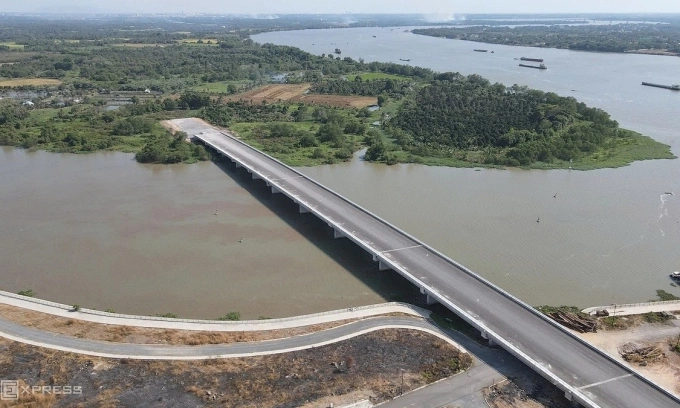
The Cat Lai Bridge is designed to stretch 11.6 kilometers, with the main span alone measuring 3 kilometers.
This bridge is designed for speeds up to 80 kilometers per hour and will feature an impressive capacity of six lanes dedicated to motor vehicles and two additional lanes for non-motorized traffic, ensuring smooth flow for all users.
Crucially, the Cat Lai Bridge will directly link Nguyen Thi Dinh Street in HCMC’s Cat Lai Ward with Dai Phuoc Commune in Dong Nai.
With an estimated total cost exceeding VND20.5 trillion, construction is anticipated to start by late 2025 and is expected to be finalized in 2028.
Complementing this is the Dong Nai 2 (Long Hung) Bridge, which will span 12 kilometers in total length, including a 2.3-kilometer bridge section itself.
This bridge will connect National Highway 51 (Tam Phuoc Ward) to Ring Road 3 (Long Phuoc Ward).
Similar to the Cat Lai Bridge, it will also feature six motor lanes and two lanes for light vehicles, with a total investment calculated to be about VND11.76 trillion.
These two massive bridge projects are set to drastically reduce travel times and ease the current congestion on the existing, heavily utilized arteries connecting these two major economic powerhouses, thereby enhancing the economic integration of the region.
Completing the Regional Transport Network for Economic Growth
According to statements released by the Dong Nai People’s Committee, the primary objective of these extensive, multi-billion-dollar projects is to achieve the critical completion of the regional transport network.
This enhancement is vital for significantly improving freight capacity and, just as importantly, shortening the overall travel times between Ho Chi Minh City, Dong Nai, and the Long Thanh International Airport, which is projected to become operational by mid-2026.
The urgent need for this infrastructure is clear, as Dong Nai and Ho Chi Minh City represent Southern Vietnam’s two largest and most dynamic economic hubs.
Despite their combined economic weight, the connectivity between them has historically been severely limited by outdated and insufficient infrastructure.
Currently, the localities are linked mainly by the Dong Nai 1 Bridge of National Highway 1, the Long Thanh Bridge of the HCMC-Long Thanh-Dau Giay Expressway, and the Nhon Trach Bridge on Ring Road 3, all of which are reaching or exceeding capacity.
The approval and subsequent planning of this new series of roads and bridges are therefore expected to initiate a fundamental transformation in regional mobility.
By dramatically improving access to the new international airport and facilitating smoother goods and passenger movement across the economic corridor, these projects are set to profoundly strengthen the entire southeast region’s economic competitiveness and lay the necessary foundation for sustained future growth.
Financial and Market Impact: De-Risking Vietnam’s Southern Economic Corridor
The $1.45 billion investment by the Dong Nai Provincial People’s Council signifies a critical pivot from provincial planning to executive action, de-risking the central economic artery connecting Ho Chi Minh City, the primary commercial hub, with the new Long Thanh International Airport (LTA).
The infrastructure bottleneck—currently represented by over-reliance on the Dong Nai 1 Bridge and limited access to the Cat Lai Port area—has historically inflated logistics costs (the Vietnam Logistics Cost Index is among the highest in ASEAN) and dampened Foreign Direct Investment (FDI) interest in peripheral Dong Nai industrial zones.
Specifically, the Cat Lai Bridge project (VND20.5 trillion) is a major catalyst. Cat Lai Port handles over 90% of HCMC’s container throughput, and the new bridge will divert heavy vehicle traffic from congested urban routes, immediately improving freight velocity and operational efficiency for manufacturing and supply chains in Dong Nai’s industrial parks (e.g., Bien Hoa, Amata).
This directly impacts the profitability of export-oriented companies operating in the Southern Economic Corridor by reducing transport-related overhead.
Furthermore, the commitment to the PPP model for the Huong Lo 2 phase signals a more mature and stable approach to project financing in Vietnam, providing confidence to both domestic construction conglomerates and international infrastructure investors.
The expected completion between 2026 and 2028, aligning with the LTA’s opening, confirms a coordinated government strategy to maximize the LTA’s function as a regional aviation hub from day one, fundamentally raising the long-term valuation of industrial land and residential property in the Dong Nai province’s designated growth districts.