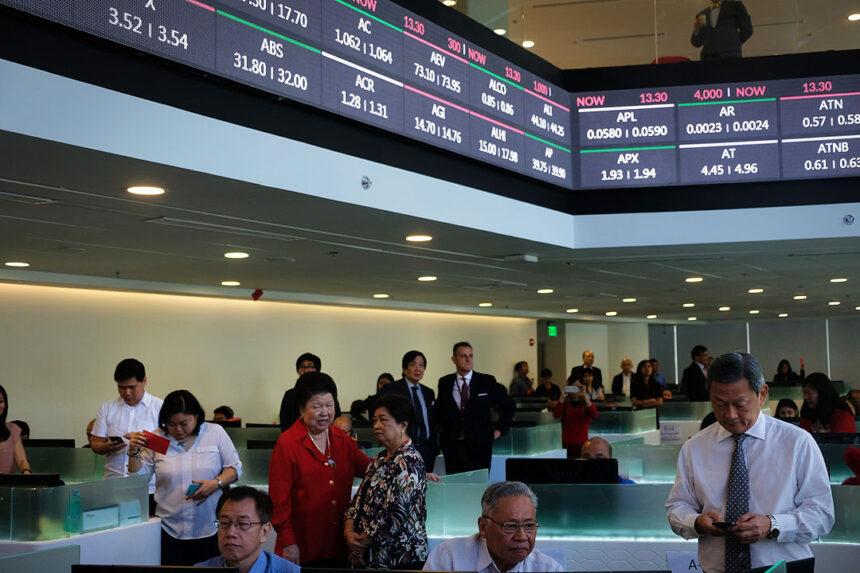
Philippine Stocks Rally as US Tariff Exemption Boosts Investor Confidence
The local stock barometer, representing Philippine stocks, successfully climbed back to the 5,800 level on Wednesday, marking a significant upswing.
This positive market movement was driven by strong investor enthusiasm following the news that over 1 billion USD worth of key agricultural exports destined for the United States secured an exemption from punitive reciprocal tariffs.
The benchmark Philippine Stock Exchange Index (PSEi) recorded a notable gain of 0.99 percent, or 57.05 points, to close the day at 5,813.71.
This indicates a clear flight of capital toward equities in reaction to the favorable trade development.
The broader All Shares Index also reflected this positive momentum, increasing by 0.63 percent, or 20.29 points, to finish at 3,251.84.
This broad market rally saw positive performances across most major sectors, with only the mining and oil sector registering losses by the close of trading.
This suggested a sector-specific weakness rather than a general market pessimism.
Despite the positive index performance, Philstocks financial research manager Japhet Tantiangco noted that overall trading activity remained “lethargic,” with the net value turnover recorded at only 5.36 billion PHP.
He attributed the day’s rise to the positive trade news, stating, “The local market rose as investors cheered the exemption of most of the Philippines’ agricultural exports from the US’ 19 percent reciprocal tariff, as mentioned by DTI Secretary Ma. Cristina Roque,” underscoring the disproportionate impact of tariff decisions on Philippine stocks and investor sentiment.
Tariff Exemption Unlocks Significant Export Market Value
The catalyst for the market’s rally was the executive order issued by US President Donald Trump, which decided to effectively junk the reciprocal tariff on specific agricultural products that cannot be produced in substantial quantities within the United States.
This crucial trade decision affects major commodity groups, including coffee, cocoa, bananas, tomatoes, and beef, providing substantial relief to Philippine producers and exporters.
The immediate impact is significant, as Board of Investments Undersecretary Ceferino Rodolfo confirmed that nearly half of the total Philippine exports to the United States will now enjoy tariff-free status.
The list of exempted items includes critical agricultural and processed food products, such as coconut and desiccated coconuts, various fruit juices, processed pineapples, frozen tuna fillets, rice wafer products, confectionery items, and dried fruits like guavas, mangoes, and mangosteen.
Considering that the Philippines’ total exports to the US amounted to a substantial 14.5 billion USD in 2024, the tariff exemption on over a billion dollars worth of goods provides a significant and immediate competitive advantage for these products in the US market.
This is crucial for the performance of associated Philippine stocks.
This removal of the 19 percent reciprocal tariff barrier immediately translates into higher revenue potential and improved margins for the agricultural and food processing firms listed on the Philippine Stock Exchange, thereby generating confidence and driving the buying activity witnessed across the market today.
Dovish Central Bank Bets Bolster Buying Activity in Philippine Stocks
In addition to the favorable trade policy news, the market received added optimism from dovish signals emanating from the nation’s central bank.
Luis Limlingan, the head of sales at stock brokerage house Regina Capital Development Corp., highlighted the significant role of the potential monetary policy shift in boosting investor sentiment.
He noted, “The investor sentiment improved after the BSP (Bangko Sentral ng Pilipinas) signaled the possibility of another rate cut by the end of the year.
This expectation continued to support buying activity in today’s session,” confirming that the prospect of lower borrowing costs provided a secondary, yet powerful, tailwind for the market.
Expectations of an interest rate cut by the Bangko Sentral ng Pilipinas typically lead to increased liquidity and lower financing costs for businesses.
This is generally viewed positively by the Philippine stocks market, as it can spur corporate investment and consumer spending.
The PSEi closed the session with a ratio showing a healthy breadth of buying interest, recording 112 gainers versus only 61 decliners, with 67 stocks remaining unchanged.
This suggests that the positive sentiment was widely distributed and not confined to just a few large-cap stocks.
The combination of reduced trade risk—due to the tariff exemption—and the anticipation of supportive domestic monetary policy created a strong psychological foundation for the market.
This encouraged risk-taking and pushing the Philippine stocks index past the 5,800 psychological level, demonstrating a strong, albeit lightly traded, show of investor faith in the near-term economic outlook.
Geopolitical De-Risking and its Structural Impact on Philippine Equities
The tariff exemption, while seemingly tactical, represents a significant structural de-risking event for the Philippine stocks market, particularly for the Consumer and Industrial sectors which house major food and beverage exporters.
The US decision provides not just immediate margin relief, but critical long-term certainty for supply chain investments, which is crucial for increasing the scale and efficiency of agricultural processing companies like those dealing in desiccated coconut and canned fruits.
This policy shift reduces the effective political risk premium historically associated with companies heavily reliant on US trade agreements, making these equities more attractive to foreign institutional investors who prioritize trade stability.
The sustained “lethargic” trading volume, despite the PSEi’s gains, suggests that while institutional and sophisticated investors recognized the trade news’ value, retail participation remains cautious, likely due to persistent domestic inflation and high interest rates.
However, the confirmation of tariff-free access strengthens the Philippines’ position as a reliable and cost-competitive regional export hub, potentially diverting Foreign Direct Investment (FDI) towards the high-growth processing and manufacturing sectors from regional competitors facing less certain US trade relations.
The dual tailwinds of export stability and anticipated BSP rate cuts create a strong Economy backdrop for cyclical stocks, supporting a positive rerating cycle for Philippine stocks over the next two quarters, provided global commodity prices remain stable and the BSP delivers on its dovish signaling.