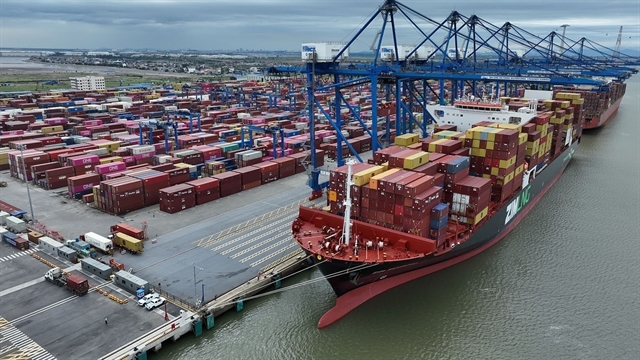
Vietnam Nears $1 Trillion Annual Trade Milestone
For the first time in its history, Việt Nam is within striking distance of achieving a monumental $1 trillion annual trade milestone. This marks a historic and profound transformation of its economic structure.
What began just four decades ago as a modest economy heavily reliant on agricultural exports, generating a mere $1 billion in total trade, has aggressively evolved. It is now a dynamic, high-tech manufacturing powerhouse that is indispensable to global supply chains.
With a confluence of factors including record-high global demand, significantly expanded domestic production capacity, and a massive wave of sustained foreign direct investment (FDI). This investment is channeled into high-tech industrial sectors, showing Việt Nam is rapidly ascending the global value chain.
This remarkable shift from an agricultural exporter to a sophisticated manufacturing hub is clearly visible in the data. The world is increasingly taking serious notice of its competitive advantage and agility.
In the first 11 months of 2025 alone, Việt Nam’s total trade has already reached an impressive $839.75 billion. This represents a robust 17.2 percent increase year-on-year, a pace that far exceeds all previous forecasts.
Current projections suggest that the economy is firmly on track to close the year with an import-export revenue figure landing between $910 billion and $920 billion. This steady, upward trajectory has firmly laid the foundation for Việt Nam to potentially hit the symbolic, yet economically significant, $1 trillion mark.
This is a feat that would immediately position it among the world’s 15 largest trading economies.
Achieving this milestone is much more than a symbolic number; it is a powerful affirmation of Việt Nam’s solidified and indispensable role in complex global supply chains. The previous year, 2024, had already been one of the strongest in its modern trade history, projected to reach between $780 billion and $800 billion.
This was driven by recovering global demand, proactive government efforts to diversify market access, and the impressive agility shown by domestic firms in navigating continuous global volatility.
High-Tech Exports Drive Value Chain Advancement
A defining and strategically crucial feature of this year’s extraordinary trade performance is the decisive shift in the composition of its export profile. This is characterized by the dominance of high-tech exports.
These sophisticated, value-added products now command a substantial 70.3 percent share of the total export value. This is a clear and irreversible transition away from natural-resource-driven growth towards technology-intensive, advanced manufacturing industries.
This shift signifies a major leap in competitiveness and value creation within the global marketplace, fundamentally altering the country’s trade identity. Proof of this deep structural change is evidenced by the growing number of product groups exceeding $10 billion in export value.
This list now prominently includes electronics, computers, mobile phones, machinery and equipment, textiles and garments, footwear, wood products, transport vehicles, and seafood. These vital sectors have not only expanded significantly in volume but have also successfully integrated themselves deeply into established global production networks.
They are moving beyond simple assembly operations. Việt Nam has firmly established itself as a critical global manufacturing hub for major electronics players.
Multinational giants such as Samsung, Intel, LG, and Foxconn are anchoring large-scale, intricate supply chains within the country.
The increasing number of export categories surpassing the $10 billion threshold powerfully underscores Việt Nam’s evolution. It moved from a destination for low-cost assembly into a sophisticated producer capable of manufacturing deeply processed and complex industrial goods, enhancing its position in annual trade.
Furthermore, a vast and expanding network of free trade agreements (FTAs) has delivered substantial and critical competitive advantages. Tariff preferences significantly enhancing the appeal and accessibility of Vietnamese goods in key international markets.
Simultaneously, the strategic utilization of these FTAs to import advanced machinery, specialized inputs, and cutting-edge technology has significantly strengthened the domestic manufacturing capacity. This ensures the momentum of the annual trade growth is maintained.
Vietnamese firms have also displayed impressive speed in adapting to the demands of cross-border e-commerce and data-driven supply chain management. They are successfully opening up new, direct channels for online exports, maximizing market reach globally.
Long-Term Trajectory And Future Competitiveness
Viewed over the long term, Việt Nam’s trade journey is best described as a remarkable parabolic curve. It started from a mere $1 billion in the mid-1980s, accelerating to $100 billion in 2007, and now rapidly approaching the $1 trillion threshold.
This historical comparison vividly illustrates a profound, successful economic reconfiguration. It moved decisively from exporting raw materials and basic goods to exporting advanced technology and deeply processed industrial products.
Today, with high-tech goods accounting for over 70 percent of total exports, Việt Nam is demonstrably climbing the global value chain. It is consolidating its position not just through expanding trade volume but through enhancing product sophistication.
This sustained momentum is crucial for ushering in a new phase where Việt Nam emerges as a modern, high-tech, export-driven economy. It is now capable of challenging the world’s largest manufacturing hubs.
International institutions are recognizing this shift, with Singapore’s UOB recently revising Việt Nam’s 2025 GDP growth projection upward from 7.5 percent to 7.7 percent. This explicitly cited robust trade activity and strengthening industrial output as key drivers.
UOB forecasts that Việt Nam is poised to play an increasingly central role internationally over the next decade. This enhances its position as a key node in regional and global production networks, particularly in advanced manufacturing and emerging technologies.
However, sustaining this next stage of development requires strategic intervention. As noted by Võ Trí Thành, PhD, who emphasizes that Việt Nam “cannot continue selling cheap” and must pivot towards value creation, supply chain innovation, and building a strong national brand.
The future of annual trade success will require deeper processing in agriculture and fisheries, greater investment in R&D, stronger branding efforts, and strict compliance with global green standards in industrial production. This is necessary to mitigate risks from trade-remedy measures in importing markets.
Regional Competition And Supply Chain Architecture
Việt Nam’s imminent achievement of the $1 trillion annual trade mark represents a significant structural shift within the Association of Southeast Asian Nations (ASEAN) economic landscape. It transcends local success to create regional implications for Business and Investment.
As high-tech exports now dominate its trade mix, Việt Nam solidifies its position as the premier destination for complex, high-value manufacturing investment in the ASEAN region. It specifically challenges the traditional dominance of Malaysia and Thailand in the electronics and automotive components sectors.
The aggressive move into the semiconductor value chain—evidenced by the $11.6 billion in FDI attracted in 10 months toward chip design, packaging, and testing. This places direct competitive pressure on Malaysia’s Penang-based semiconductor packaging and assembly industry.
This forces regional peers to accelerate their own value proposition upgrades from assembly to higher-end design and materials R&D. This is necessary to remain relevant in the evolving supply chain architecture.
Furthermore, Việt Nam’s reliance on FDI-led export growth, demonstrated by the FDI sector’s 25.1 percent increase in total import-export turnover, creates an implicit competitive dynamic for capital attraction. This is against Indonesia and the Philippines, particularly in the race to secure further China+1 strategy relocations.
However, this success is also a regional stabilizer: by offering a highly diversified, FTA-integrated manufacturing base, Việt Nam reduces the ASEAN region’s overall vulnerability. This is a vulnerability to single-country production disruptions, enhancing the resilience and attractiveness of the entire Southeast Asian supply chain block for global multinationals.
From a Finance perspective, the consistent trade surplus (over $20 billion) and sustained FDI inflows stabilize the Vietnamese Dong (VND). This differentiates it from other regional currencies facing volatility.
This strengthens macro-economic stability, which is a key factor for foreign investors. This suggests a long-term premium on Việt Nam’s sovereign debt and equity markets compared to some ASEAN neighbors who face persistent trade deficits or currency pressures.