Five Years On, the EVFTA is Hailed as a Success Despite Trade Imbalance
Five years after the Việt Nam – EU Free Trade Agreement (EVFTA) entered into force, both signatory sides have enthusiastically hailed the landmark deal as an undisputed success, while simultaneously acknowledging the crucial need to address remaining trade barriers and strategically move toward establishing a more balanced trade relationship.
The agreement has solidified Việt Nam’s position as the European Union’s largest trading partner within ASEAN, with the bilateral trade volume surging to nearly EUR64 billion.
Trade in goods alone has experienced a remarkable rise of 47 percent over the past five years, a statistic that European Commissioner for Trade and Economic Security, Maros Sefcovic, described as “a real success and a reflection of the strong dynamic between the EU and Việt Nam.”
However, the success has been markedly uneven.
Exports originating from Việt Nam to the EU have grown sharply, increasing by an impressive 60 percent since the EVFTA took effect, adding a substantial US$20 billion in total export value.
In contrast, EU exports flowing into Việt Nam increased by a much smaller 10 percent, equivalent to approximately $1 billion.
This clear trade imbalance has prompted both sides to intensify talks on how to design and implement measures that can create more reciprocal benefits for European businesses.
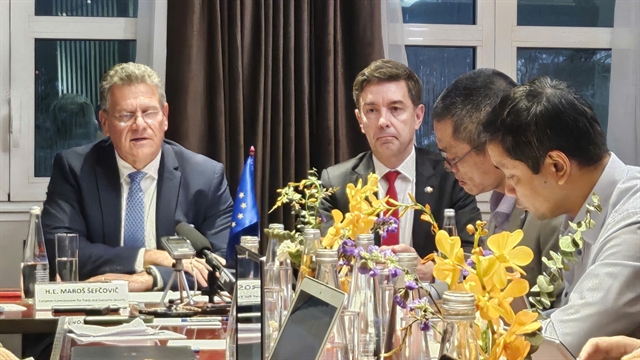
Sefcovic candidly noted at a press conference on September 26, after co-chairing the EVFTA committee with Vietnamese Minister of Industry and Trade Nguyễn Hồng Diên, that “The truth is that Việt Nam is doing better than Europe right now.”
Addressing Technical Barriers and Streamlining Approvals
To rectify the current trade asymmetry and boost European exports, the focus of the EVFTA committee discussions has shifted to tackling specific technical barriers, particularly simplifying sanitary, phytosanitary, and automobile standards.
Sefcovic confirmed, “Therefore, we have been discussing with Minister Diên how to achieve more balance in our mutual trade,” adding that “We went through a list of very concrete measures, what all still need to be implemented or where we need more cooperation.”
Among the priority technical issues identified are the sanitary and phytosanitary (SPS) permits required in the agricultural sector, along with technical standards currently in place within the automobile sector.
The Commissioner proposed a significant simplification of Việt Nam’s approval process by suggesting the mutual recognition of EU-wide certifications.
He argued for a unified approach: “If the permit is given for facilities in one of the EU member states, it should be automatically issued for the rest because we have the same regulations, same controls and same standards.”
He assured that the European Commission would reciprocate this policy in favor of Vietnamese exporters, ensuring fairness.
Both parties also agreed to immediately form a special joint task force, comprising high-level officials from key ministries including agriculture, trade, and foreign affairs, specifically to address all outstanding implementation issues and ensure the smoother, more effective application of the EVFTA.
Sefcovic stated that this task force “will analyse and evaluate all concerns in a thorough way to make the agreement more efficient, more balanced and to help both sides maximise their full potential.”
Expanding Strategic Cooperation Beyond Goods
Beyond the immediate concerns of goods trade and technical standards, both the EU and Việt Nam are committed to leveraging the EVFTA as a foundational platform to deepen strategic cooperation in future-forward sectors, further cementing their long-term partnership.
The high-level discussions touched upon broadening strategic cooperation in areas of critical raw materials, crucial for high-tech manufacturing, as well as renewable energy, semiconductors, and logistics infrastructure.
Telecommunications and transport were also singled out as particularly promising sectors for future investment and growth under the EVFTA framework.
The EU warmly welcomed Việt Nam’s recent decision to join the WTO’s Multi-Party Interim Appeal Arbitration Arrangement (MPIA), viewing it as a clear signal of the country’s continued commitment to multilateralism and the rules-based global trading system.
Sefcovic stressed that the EVFTA’s ultimate value extends far beyond mere trade volumes, encompassing shared prosperity and closer political and economic ties.
He summarized the broader impact of such agreements: “All our free trade agreements have several features in common: they lead to the increase of trade, they increase investment, they create new jobs. And through proper implementation, they bring partners closer politically and economically and at the level of people-to-people contacts.”
Looking regionally, the Commissioner shared other successful developments during his trip, including the conclusion of a free trade agreement with Indonesia.
The EU is also actively negotiating similar deals with the Philippines, Thailand, and Malaysia, with the ambitious long-term goal of building toward a comprehensive region-to-region pact with all of ASEAN before the 50th anniversary of the ASEAN-EU dialogue in 2027.
For Việt Nam, while the EVFTA has opened unprecedented export opportunities, policymakers acknowledge that sustainable success hinges on tackling technical barriers and ensuring European companies feel equally welcomed and incentivized to invest and export.