Capitalizing on Geopolitical Shifts for Indonesia’s Investment Gains
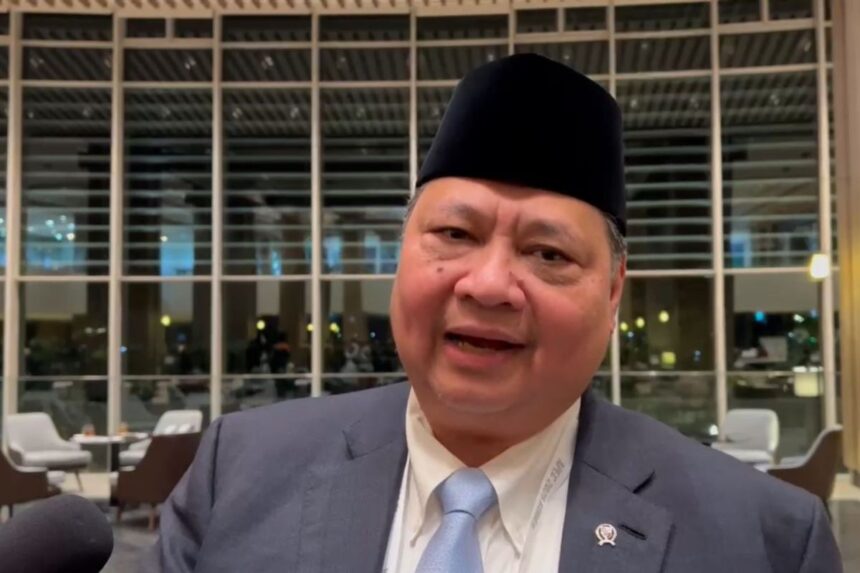
Coordinating Minister for Economic Affairs Airlangga Hartarto views the upcoming 2025 APEC Summit as an essential platform for Indonesia to significantly capture new regional investment gains, especially following the highly anticipated meeting between US President Donald Trump and Chinese President Xi Jinping.
He holds the conviction that the face-to-face meeting between the two leaders in Busan on Thursday, October 30, offered much-needed clarity regarding the future direction of tariff policy throughout the broader Asia-Pacific region.
Speaking from the sidelines of the 2025 APEC Summit in Gyeongju City, South Korea, on Friday, Hartarto affirmed that “Indonesia is open to investment from strategic partners in the region.
APEC is considered important because President Trump and President Xi Jinping had just met. For Indonesia, the tariff corridor has become clearer.”
The Minister expressed optimism that this direct dialogue—their first in six years—would contribute to easing the recently intensified global trade tensions that have created uncertainty across numerous sectors.
This clarity on trade policy and tariffs is fundamentally important for Indonesia’s economic planning, allowing the government to better position its domestic industries and ensure they remain competitive.
The successful negotiation of tariffs and the subsequent push for regional integration at APEC are key to unlocking substantial foreign direct investment, thereby increasing the potential for significant investment gains for the Indonesian economy.
Strengthening Economic Diplomacy Amidst Evolving Trade Dynamics
Minister Hartarto underscored the critical importance of actively engaging in economic diplomacy at the APEC Summit to leverage the newly established trade clarity.
He pointed out that several trade tariff agreements were successfully concluded among various APEC member economies, specifically mentioning commitments from countries like Malaysia, Cambodia, and South Korea.
Hartarto emphasized Indonesia’s need to meet regional benchmarks, stating, “Korea itself has agreed to 15 percent, and we must reach that level,” signaling a proactive approach to aligning Indonesia’s trade policies with its key partners.
In this context of evolving global trade, maximizing Indonesia’s appeal for foreign direct investment becomes paramount.
The Minister also revealed that he held a strategic meeting with South Korea’s Minister of Industry, Trade, and Energy, whom President Trump had publicly described as one of his toughest negotiating partners.
This meeting, according to Hartarto, was deliberately scheduled to strengthen bilateral economic cooperation and ensure that Indonesia maintains a highly competitive standing amidst the rapidly shifting trade dynamics triggered by the recent U.S.–China summit.
The focus of these high-level discussions is squarely on securing Indonesia’s access to key markets and ensuring that the country remains a favored destination for future investment gains.
Maintaining this competitive advantage requires continuous dialogue and adjustment to prevailing geopolitical and economic currents, ensuring the nation’s economic resilience.
APEC Summit Provides a Global Stage for Dialogue
The 32nd APEC Summit, attended by President Xi Jinping, served as a vital global stage where major world leaders could address not only trade but also broader regional and international challenges.
The meeting between the US and Chinese presidents marked a significant diplomatic development, injecting a sense of measured optimism into the global economic outlook.
President Xi Jinping utilized the opportunity to reaffirm China’s commitment to strengthening the foundational relationship between China and the U.S., focusing on the creation of a favorable environment conducive to shared development and global stability.
According to Xi, President Trump expressed a strong enthusiasm for collaboratively resolving key regional issues, signaling a potential shift towards greater cooperation.
Xi highlighted the broader context, noting, “China has also pushed for peaceful negotiations to resolve major issues. The world is currently facing many serious challenges,” underscoring the necessity of high-level dialogue for de-escalation.
For Indonesia, the successful dialogue between the two global economic powers at APEC is crucial because it reduces market volatility and trade uncertainty, which directly improves the prospects for sustained investment gains and economic stability within the ASEAN region.
The Summit provided Indonesia with the chance to both observe and actively participate in shaping the new post-summit trade environment.