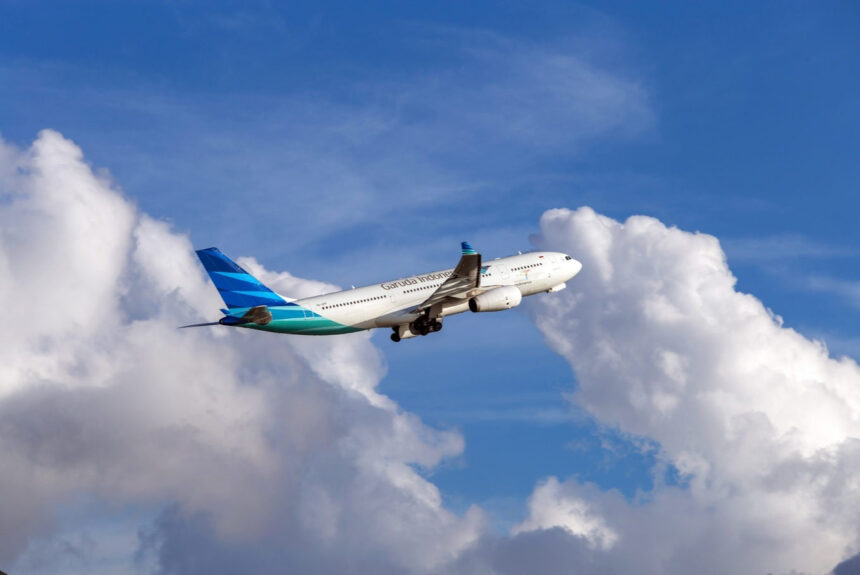
Garuda Indonesia Plans Major Private Placement to Boost Capital
The national airline, PT Garuda Indonesia, is charting a course for financial stability and operational support by announcing plans to issue a substantial number of Series D shares.
Specifically, Garuda Indonesia intends to issue 315.6 billion Series D shares, a corporate action designed to raise a significant Rp 23.67 trillion (approximately US$1.4 billion) in fresh capital.
This considerable fundraising effort will be composed of two distinct components: Rp 17.02 trillion in new capital deposits and Rp 6.65 trillion derived from the conversion of existing shareholder loans into equity.
The primary goal of this strategic private placement is twofold: to provide essential support for the airline’s core operations and to fundamentally strengthen its overall financial position following a challenging period of restructuring.
The shares are slated to be issued through a private placement mechanism at a price of Rp 75 per share.
A disclosure document released by the state-owned enterprise (SOE) confirmed that the transaction will involve the state asset fund Danantara, acting in the dual capacity of both investor and creditor.
A calculated 37 percent of the total funds raised will be strategically allocated to Garuda Indonesia’s direct working capital and essential operations, including crucial aircraft maintenance and repair activities, which are vital for maintaining flight safety and service reliability.
The company is proactively taking this financial step to ensure its longevity and capacity for sustainable growth in the highly competitive regional aviation market.
Strategic Allocation of Funds to Strengthen the Group’s Financial Structure
The remaining and more substantial portion of the raised capital, accounting for 63 percent of the total proceeds, is earmarked for the group’s subsidiary, Citilink.
This strategic allocation is designed to bolster Citilink’s working capital through the conversion of its existing shareholder loans into a cash capital deposit, thereby cleaning up its balance sheet.
A critical component of the funding is dedicated to allowing Citilink to repay its significant $225 million debt owed to the state-owned oil and gas holding company, Pertamina.
This debt repayment is a crucial step in streamlining the group’s internal financial obligations and reducing risk exposure.
The management of Garuda Indonesia expressed strong confidence in the anticipated impact of this share issuance, stating that the corporate action is expected to yield a profoundly positive influence on the company’s financial position.
Specifically, the private placement will directly increase the company’s equity, significantly strengthen its capital structure, and is designed to support the long-term sustainability of the company and all its subsidiaries in the future.
This strategic move, which has received key approvals, is viewed as a foundational element of the broader restructuring plan.
The company confirmed that the share issuance was due to be discussed at its general shareholders meeting on November 12.
Crucially, the move has already secured the necessary high-level endorsement, with the SOEs Regulatory Agency (BP BUMN) and President Prabowo Subianto having approved the plan as an integral part of the comprehensive corporate restructuring process that the national flag carrier has been undertaking.
Projected Financial Improvement and Long-Term Stability
The management of Garuda Indonesia holds optimistic projections regarding the tangible financial improvements expected to result from the successful execution of this private placement.
The company specifically projects that its equity position will dramatically improve, reaching an estimated $183 million by the end of the current fiscal year, a significant turnaround from its previous standing.
Furthermore, the company anticipates that its current ratio, a key indicator of liquidity and ability to cover short-term liabilities, will experience a massive boost, increasing substantially from 0.44 to a much healthier and more stable 1.22.
This projected enhancement in the current ratio is particularly vital, as a figure above 1.0 indicates that the company possesses sufficient liquid assets to cover its short-term debts, restoring creditor confidence and improving operational flexibility.
The restructuring, of which this private placement is the central pillar, is designed to address the deep financial challenges the airline accumulated over the past few years, ensuring that Garuda Indonesia can operate on a sounder financial footing going forward.
By clearing internal debts, injecting new cash, and converting loans to equity, the company is fundamentally altering its debt-to-equity profile.
This action positions the group not just for immediate operational relief but for a robust return to profitability and expansion within the dynamic Southeast Asian aviation sector, fulfilling its role as the national flag carrier with greater stability and resilience.
Financial Analyst Commentary: Stabilizing the National Aviation Ecosystem
The substantial Rp 23.67 trillion capital injection into Garuda Indonesia is a necessary, sovereign-backed intervention to stabilize a systemic risk within Indonesia’s transport and logistics backbone.
The immediate market impact is primarily one of confidence and de-risking. The conversion of Rp 6.65 trillion in shareholder loans to equity is a crucial balance sheet cleansing measure, significantly reducing the Debt-to-Equity ratio from critically high levels, which should immediately lower the company’s cost of capital on future borrowings.
The target current ratio of 1.22 is particularly significant, shifting the perception of Garuda from a distressed asset (current ratio of 0.44) to a commercially viable enterprise, making it more appealing to non-state institutional investors in the medium term.
Furthermore, the 63% allocation to Citilink, including the repayment of the $225 million Pertamina debt, serves two strategic functions: it strengthens the low-cost carrier (LCC) segment, which is the primary growth engine in the ASEAN aviation market, and it optimizes the cash cycle within the broader state-owned ecosystem by extinguishing an intra-SOE obligation.
Regionally, a financially robust Garuda Indonesia is vital for challenging the dominance of regional competitors like Singapore Airlines and Malaysia Airlines, especially in the lucrative long-haul and international transit markets, thereby protecting Jakarta’s ambition to become a major Southeast Asian aviation hub.
The successful execution of this private placement is a strong signal of political commitment, but the long-term financial success will ultimately depend on Garuda’s ability to transition from sovereign support to sustained operational profitability by leveraging its new capital structure to expand routes and modernize its fleet without recurring capital calls.