President Prabowo Announces Debt Relief for Aceh Farmers’ KUR Loans
President Prabowo Subianto officially declared that the government will implement a comprehensive debt relief measure, canceling the existing Smallholder Business Credit (KUR) debts for farmers in Aceh who have been severely affected by the recent catastrophic floods and landslides.
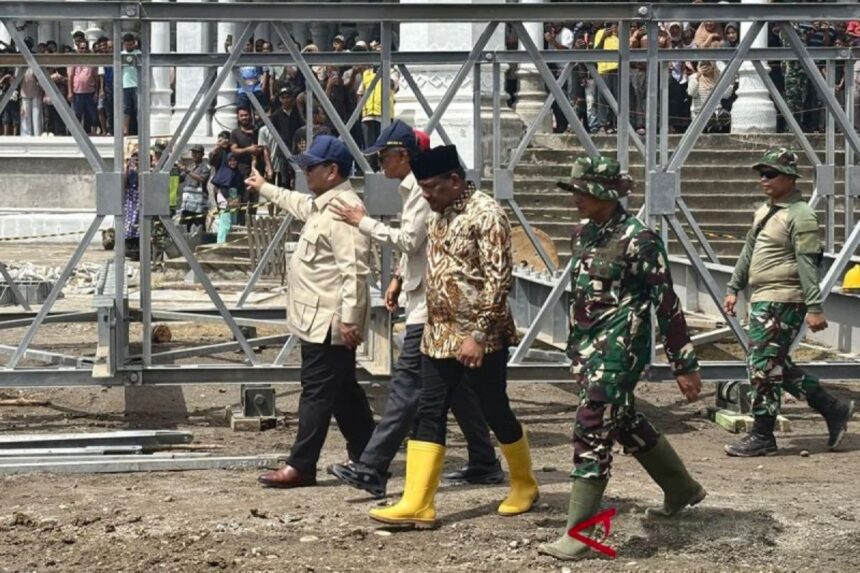
Making the announcement during a press statement while inspecting the Teupin Mane bailey bridge in Bireuen, Aceh, on Sunday, the President stated, “As for KUR debts, since this is a natural disaster, we will cancel them.”
This decisive action recognizes the extraordinary circumstances faced by the agricultural community, whose livelihoods have been drastically impacted.
The President elaborated that the debt cancellation is specifically justified because the disaster constitutes a force majeure event, a legal term signifying an unavoidable event caused by natural forces, thereby ensuring that farmers need not worry about the obligation of repaying their existing government-backed loans.
He emphasized this point directly to the affected populace: “Farmers should not worry about being unable to repay debts, because this is not negligence but a forced situation, a force majeure.”
This move aims to stabilize the local agricultural Economy by removing an immediate Finance burden, allowing farmers to focus their limited resources and energy entirely on physical recovery and future Investment rather than crippling debt repayment.
The government’s swift response utilizes the KUR mechanism not just as a credit provider, but as a critical social security and disaster recovery tool for MSMEs in the agricultural sector, showcasing a commitment to protecting the nation’s food security base during an unexpected crisis.
Accelerated Infrastructure and Agricultural Rehabilitation Efforts
In addition to the crucial debt relief initiative for KUR loans, President Prabowo detailed the ongoing, urgent efforts across the government to accelerate all aspects of recovery in the flood- and landslide-affected regions of Aceh.
He confirmed that essential infrastructure repairs, such as the restoration of damaged bridges, are being prioritized, with a specific target for the key routes to reopen within one to two weeks, ensuring the rapid reinstatement of local Economy and supply chains.
During his inspection of the temporary 30-meter Teupin Mane bailey bridge—a critical lifeline connecting the Bireuen and Takengon districts in Central Aceh—the President observed construction points along the riverbank and checked heavy equipment operations, including excavators and loaders, working nonstop to strengthen the vital access route.
The President also received detailed reports concerning damaged dams and the vast tracts of affected rice fields belonging to local farmers.
In response, the government has made a firm commitment to immediately and fully rehabilitating the damaged farmland, prioritizing the repair of these vital agricultural assets.
He assured the farming community that their livelihoods were a top priority: “Farmers do not need to worry if their fields are damaged. We will help repair them, that is our priority.”
Furthermore, to ensure that the food supplies for the affected region remain stable during the recovery period until local production is restored, the government is sending aid from other regions, reaffirming that national food reserves are still sufficient to cover the gap.
This coordinated Investment in both infrastructure and agricultural assets is designed to stabilize the regional Economy following the disaster.
Strategic Rationale: Force Majeure and Economic Stability Investment
The government’s decision to grant debt cancellation for the KUR loans of Aceh’s affected farmers is rooted in a clear strategic rationale that extends beyond immediate humanitarian aid, focusing instead on long-term regional Economy stability and Finance integrity.
By formally declaring the disaster a force majeure, the President sets a strong legal precedent that distinguishes losses due to natural catastrophe from typical credit default risk.
This is vital for the KUR-lending banks, as it provides a clear mechanism for the government, rather than the banks or the farmers, to assume the loss, preventing a cascade of non-performing loans (NPLs) on the banks’ balance sheets that could destabilize the regional Finance sector.
The immediate and complete removal of this debt obligation acts as a profound economic stimulus, freeing up what little remaining capital the farmers may have for critical short-term needs such as purchasing new seeds or repairing small equipment, which is a necessary initial Investment to restart their Businesses.
The inspection of the bailey bridge and the focus on logistics are complementary, ensuring that once the farmers restart production, the physical infrastructure is in place to move goods to market.
This coordinated approach—combining direct financial debt relief with hard infrastructure repair—demonstrates a comprehensive government strategy to not only support the Bumiputera and local communities in Aceh but also to protect the national agricultural supply chain and ensure sustained food security across Indonesia.
The use of debt relief for the KUR program is thus a targeted Finance policy designed for maximum stabilization and recovery impact on the local Economy.
Financial Analyst Commentary: Sovereign Risk Management and Moral Hazard Mitigation
The outright cancellation of KUR debt due to a declared force majeure serves as a direct, high-impact sovereign risk management tool that minimizes second-order economic casualties.
From a Finance perspective, this action directly transfers the Investment loss from the individual MSME farmers, who have zero capacity to absorb it, to the central government’s fiscal budget.
This prevents the financial distress of thousands of small Businesses from translating into systemic regional bank insolvency or a permanent contraction of the local Economy.
A critical consideration for the $\text{ASEAN}$ region is the management of moral hazard; the explicit linkage to force majeure (natural disaster) is essential.
This specificity limits the precedent, distinguishing it from general credit default and preventing the expectation of future debt relief for poor Business performance, which protects the long-term integrity of the KUR program.
The collateral effect is the stabilization of rice and cash crop futures in Aceh, as the government’s commitment to land rehabilitation and supplementary food aid de-risks the expected post-disaster supply gap.
This government-backed Investment effectively acts as a crop insurance mechanism, stabilizing agricultural Finance flows and ensuring price predictability, which benefits not only the local farmers but also consumers across the wider Indonesian Economy.