Boosting Bilateral Trade and Investment Through Enhanced Connectivity
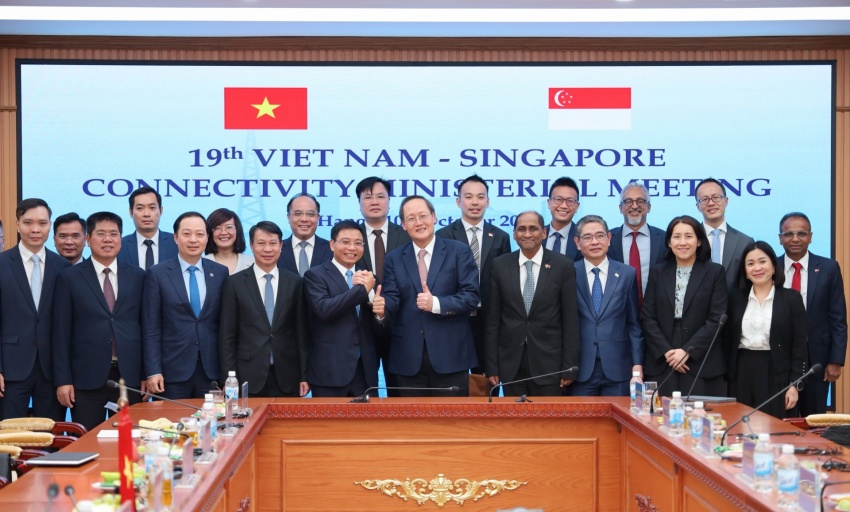
Vietnam and Singapore have successfully concluded their 19th Connectivity Ministerial Meeting (CMM), co-hosted by Vietnam’s Minister of Finance Nguyen Van Thang and Singapore’s Minister for Manpower and Minister-in-charge of Energy and Science and Technology, Tan See Leng.
The meeting, held on October 10, served as a crucial platform to explore and promote new cooperation proposals across a wide range of sectors, including investment, agricultural trade, transport, construction, infrastructure, and energy, laying robust groundwork for deeper engagement.
Both sides stressed the importance of continued private-sector involvement, welcoming Singapore’s enduring role as Vietnam’s second largest foreign investor.
This strong investment relationship is exemplified by major projects such as the third phase of Keppel’s Saigon Centre and Shopee’s fourth automated sorting centre in Hung Yen province, which are significant contributors to the deepening economic ties.
Foreign direct investment (FDI) inflows into Vietnam demonstrated strong momentum, reaching over $28.5 billion in the first nine months of the year, marking an 8.5 per cent increase year-on-year.
Singapore alone accounts for an accumulated total of 4,226 projects valued at $87.6 billion through the end of September, showcasing its foundational role in Vietnam’s economic development.
Conversely, Vietnamese investment into Singapore has also seen healthy growth, with 190 projects now valued at $685 million, illustrating the increasingly reciprocal nature of their economic partnership.
The focus on key sectors like transport and trade is vital for maximizing the benefit of these investments, ensuring efficient movement of goods and capital across the region.
New Frontiers in Sustainability and Digital Connectivity
The 19th CMM highlighted significant strides in emerging sectors, particularly in sustainable development and the digital economy.
On agricultural trade, the meeting celebrated Singapore’s recent approval of heat-treated poultry exports from Vietnam, which began in March, opening new market access for Vietnamese products.
Further institutional collaboration is underway with the Singapore Food Agency (SFA) and Vietnam’s Ministry of Agriculture and Environment working to establish a joint agri-food task force, and the SFA is in active discussions with Vietnam’s Ministry of Industry and Trade regarding a Rice Cooperation Agreement to secure stable supply chains.
The commitment to green transition was strongly affirmed with the signing of an agreement on implementing Article 6 of the Paris Agreement on September 16.
In the energy domain, both sides finalized a joint report on offshore wind power cooperation and reiterated the strategic importance of a direct Vietnam-Singapore undersea cable, which is deemed a “backbone” for Singapore’s low-carbon energy import strategy, securing future energy trade.
On the digital front, cooperation is intensifying following the signing of an MoU in March between Vietnam’s Ministry of Science and Technology and Singapore’s Ministry of Development and Digital Information.
The two nations are finalizing a detailed plan for 2025-2026, which will heavily focus on enhancing digital connectivity and digital transformation across emerging technologies, research and development, digital talent cultivation, digital innovation, and support for digital startups.
Vietnam is also actively considering applying for observer status in the Digital Economy Partnership Agreement, a move that would further streamline digital trade and collaboration.
Strengthening Logistics, Talent, and Financial Linkages
The collaborative efforts also extended to enhancing logistics capabilities, talent mobility, and financial integration, all crucial for supporting the growing volume of bilateral trade.
Vietnam put forward a proposal to expand the bilateral Air Services Agreement to include fifth-freedom cargo rights, an initiative aimed at establishing Vietnam as a key regional air logistics hub and an even more attractive tourism destination.
Vietnam is also actively seeking investment from Singapore in aircraft parts manufacturing, capitalizing on its unique position as one of the few nations capable of exporting commercial aircraft parts to the United States without incurring tariffs, showcasing a high-value potential area for technology transfer and trade.
Progress was also acknowledged in the Innovation Talent Exchange programme and broader labour cooperation, with new criteria opening avenues for specialized talent and knowledge transfer.
Institutions like Singapore’s Advanced Remanufacturing and Technology Centre and Vietnam’s National Innovation Centre, along with the established Vietnam-Singapore Industrial Parks, are engaged in tripartite collaboration to strengthen Vietnam’s digital manufacturing capabilities.
In the financial sector, the meeting promoted ongoing collaboration in payment connectivity between the Monetary Authority of Singapore and the State Bank of Vietnam.
A tangible outcome is the partnership between Singapore’s NETS and Vietnam’s National Payment Corporation to implement cross-border QR code payment connectivity, which is expected to go live next year, significantly easing financial trade and tourism.
The 20th CMM, which will be hosted by Singapore under the rotating mechanism, will continue to build upon these broad, multi-sectoral foundations.