Brazil and Indonesia Seek to Triple Trade via Accelerated PTA Talks
Brazilian President Luiz Inácio Lula da Silva stated that economic ties between Brazil and Indonesia hold a significant growth potential, vastly exceeding the current trade volume of about US$6 billion over the past two decades.
President Lula pressed the issue with Indonesian President Prabowo Subianto, questioning why two large countries, which together represent nearly 500 million people, only maintain trade worth such a small figure.
To rectify this underperformance and unlock the true economic synergy between the two global giants, both leaders have agreed to accelerate negotiations on a Preferential Trade Agreement (PTA) between Mercosur and Indonesia.
Their joint aim is to finalize this crucial trade deal before Brazil’s current presidency of Mercosur concludes in December.
In 2024, Indonesia was the fifth-largest destination for Brazilian agribusiness exports; however, Lula stressed that this figure is modest when considering the sheer size and potential of the two nations, which are the fourth and seventh most populous globally.
Since President Prabowo’s state visit to Brazil in July, cooperation between the two countries has already seen a tangible expansion, notably including improved market access for key Brazilian exports into Indonesia.
This focus on an ambitious PTA underscores a shared commitment to deepening economic relations and transforming the current trade dynamic from one of minor collaboration into a major strategic partnership that reflects their respective global stature and combined demographic strength.
Expanding Cooperation Beyond Traditional Agribusiness Trade
The renewed focus on a comprehensive Preferential Trade Agreement goes beyond traditional commodity trade, aiming to unlock opportunities across high-value sectors, including defense, energy, and critical mineral resources.
President Lula specifically highlighted the promising prospects for trade in value-added goods and services, particularly in the defense sector.
He pointed to Brazil’s advanced military industry and expressed the country’s readiness to support the requirements of Indonesia’s Air Force, indicating a mutual desire to deepen strategic security cooperation alongside economic ties.
In the energy sector, discussions between the two leaders centered on strengthened collaboration regarding the management and supply of critical mineral resources.
These minerals are essential for driving the global clean energy transition, making this area of cooperation strategically important for both nations’ long-term development.
To solidify this commitment, collaboration in the mining industry will be significantly strengthened through a recently signed Memorandum of Understanding (MoU) between their respective energy ministers.
The finalization of the PTA is viewed as the crucial framework that will facilitate increased investment and trade in these advanced sectors, ensuring that the economic relationship evolves from a basic buyer-seller dynamic into one of shared strategic industrial development.
This will allow the partnership to fully capitalize on Indonesia’s status as a key global strategic player and Brazil’s industrial and technological capabilities.
High-Level Dialogue Sets Stage for Bilateral Partnership
President Lula’s state visit to Jakarta, which spanned October $22-24$, was a pivotal stop on his broader Southeast Asia tour and marked his second official visit to Indonesia since 2008, underscoring the strategic importance Brazil places on this burgeoning relationship.
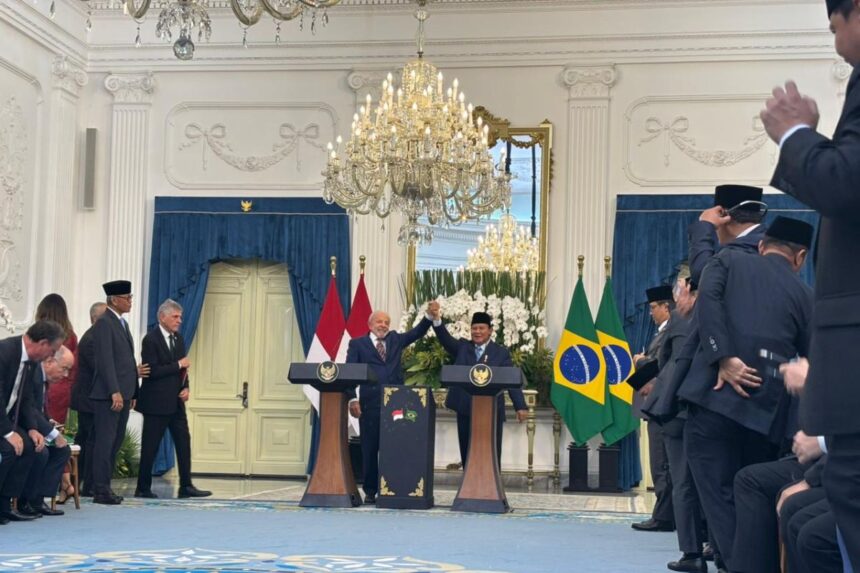
The visit was characterized by a series of high-level engagements at Merdeka Palace, which included a private one-on-one discussion (tête-à-tête) between the two presidents, a comprehensive bilateral government meeting involving key ministers and officials, and the issuance of the joint statement confirming the acceleration of the PTA talks.
This extensive, multi-layered diplomatic effort is designed to swiftly translate high-level political commitment into concrete, actionable economic and strategic outcomes, which is necessary to overcome the historical trade stagnation that has plagued the relationship.
The decision to finalize the Preferential Trade Agreement before the end of the Mercosur presidency in December highlights the urgency and political will driving this process.
This intensified bilateral engagement reflects a shared recognition that the current US$6 billion trade volume is a vast underperformance for two of the world’s most populous and resource-rich emerging economies.
Successfully concluding the PTA will not only boost agricultural trade but also embed the cooperation across defense, mining, and technology, cementing a comprehensive strategic partnership for the coming decades.