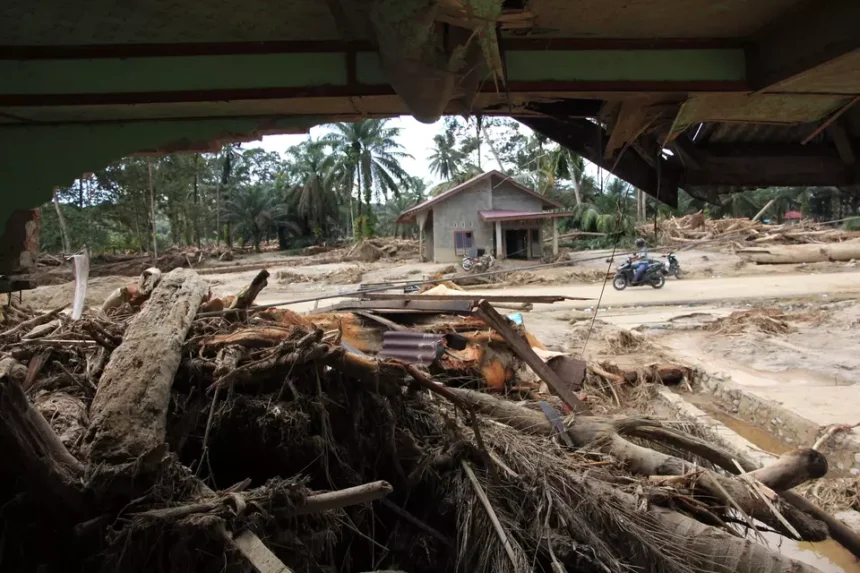
Economic Impact of Cyclone-Induced Floods and Landslides
Indonesia faces estimated national economic losses totaling Rp 68.67 trillion, or approximately $4.1 billion, stemming from the devastating cyclone-induced Sumatra floods and landslides that struck the island. This staggering figure, calculated by the think-tank Celios based on data available as of November 30, reflects the wide-reaching consequences of the catastrophe, which extend far beyond the immediate disaster zones.
The report emphasizes that a major disaster in one key province, particularly in an industrial hub like North Sumatra, can critically disrupt vital national transportation arteries. This disruption in logistics subsequently affects the flow of essential goods, impacting both end consumers and core industries across the entire Indonesian archipelago.
Celios’s executive director, Bhima Yudhistira, explained that the total estimated decline in the national gross domestic product (GDP) is around 0.29 percent, directly attributable to the Sumatra disasters. This comprehensive calculation incorporates a broad spectrum of damages, including physical destruction of homes, damage to critical road and bridge infrastructure, and significant loss of household income, especially in the crucial agricultural production sector within Sumatra.
The financial impact is geographically dispersed and surprisingly extensive; for instance, while Aceh suffered Rp 2.04 trillion and North Sumatra experienced losses of Rp 2.07 trillion, even Jakarta, far removed from the disaster epicenter, faced estimated economic losses of Rp 1.88 trillion due to supply chain disruption. The highest provincial financial damage was recorded in Jambi and Bengkulu, both severely impacted provinces on the island, each suffering Rp 2.08 trillion in estimated losses, underscoring the severity of the damage across the Sumatra region.
Ecological Factors and the Spreading Financial Damage
The far-reaching financial damage caused by the Sumatra floods and landslides, impacting provinces on the opposite side of the country like North Maluku with an estimated Rp 2.08 trillion in losses, highlights the interconnected nature of Indonesia’s national Economy and the underlying ecological drivers of the crisis. According to Bhima Yudhistira of Celios, the root cause of these increasingly severe and frequent ecological disasters is fundamentally linked to detrimental land conversion practices.
He explicitly pointed to widespread deforestation, the rapid expansion of oil palm plantations, and unchecked mining activities as the primary catalysts that have exacerbated the severity of the floods and landslides. This environmental degradation reduces the land’s capacity to absorb heavy rainfall, transforming intense weather events into catastrophic human and financial losses.
The urgent recommendation from Celios is the need for an immediate moratorium on the issuance of new mining permits and the expansion of oil palm plantations across Sumatra and the wider archipelago, arguing that addressing these ecological stressors is paramount to mitigating future economic harm. The financial figures clearly demonstrate that the disaster’s ripple effect is not limited to physical damage but represents a nationwide economic shock that severely impairs various sectors, far exceeding the initial cost of physical reconstruction.
The sheer volume of the estimated financial damage necessitates a shift in government policy focus from purely reactive disaster response to proactive environmental protection and sustainable land use planning to safeguard the nation’s long-term Economic stability and prevent the recurrence of such high-cost catastrophes across the regions most vulnerable to the ongoing effects of climate change and environmental mismanagement.
Official Response and the Call for National Emergency Status
Beyond the significant financial repercussions across the Indonesian Economy, the Sumatra floods and landslides resulted in a severe humanitarian crisis, with disaster authorities reporting a grim toll: at least 631 people confirmed dead, 2,600 individuals injured, and approximately 472 people still unaccounted for as of the latest reports. The physical damage to residential areas was catastrophic, with around 3,500 houses sustaining severe damage, requiring massive aid and reconstruction efforts.
President Prabowo Subianto visited the disaster-hit areas on Monday; however, despite the soaring civilian casualties and the widespread financial and infrastructural damage detailed by Celios, he opted not to immediately rush into imposing a national emergency status. This status, if declared, would significantly expedite coordination, resource allocation, and mobilization of all government apparatus and resources to the affected areas, especially in the hardest-hit parts of Sumatra.
When questioned about the possible elevation of the disaster status, the President told the press that the “situation had improved,” indicating a cautious, wait-and-see approach while emphasizing that he would continue to closely monitor the latest developments. Indonesia’s disaster management protocol outlines emergency statuses ranging from city or regional level up to provincial, with the national emergency being the highest classification.
A national emergency is typically declared only after careful consideration of several critical factors, including the death toll, the sheer magnitude of financial losses, the extent of infrastructure damage, and the overall socio-economic impact on the affected regions, criteria that the Sumatra disaster arguably met or exceeded based on the data provided by independent think tanks.
Regional Market Impact: Commodity Prices and Logistical Bottlenecks
The devastating Sumatra floods are poised to generate significant, immediate instability in the regional market for key Indonesian commodities and pose a systemic threat to domestic price stability, compounding the original economic loss estimate. The northern and western parts of Sumatra—Aceh, North Sumatra, and West Sumatra—are critical production hubs for agricultural output, including palm oil and horticultural products, which are vital for both the national food supply and exports.
The massive infrastructure damage, particularly to roads and bridges, creates acute logistical bottlenecks that isolate producing regions, leading to sharp price spikes in basic necessities such as rice and fuel in cut-off areas. For instance, reports show the price of rice and Pertalite fuel has dramatically escalated in isolated pockets, demonstrating a localized, cost-push inflation shock far exceeding national averages.
Furthermore, the disruptions to supply chains for major Investment sectors, such as the Batang Toru region which hosts gold mining and hydroelectric projects, create uncertainty for listed Businesses dependent on continuous operation in Sumatra. While the central government has mobilized relief efforts to address immediate food and energy shortages, the prolonged inability to move goods and raw materials out of the region will likely translate into depressed local revenue and increased regional deficits, placing pressure on regional budgets to cover unexpected reconstruction costs and further highlighting the non-proportionality of regional tax contributions from extractive industries compared to the ecological and financial losses incurred.