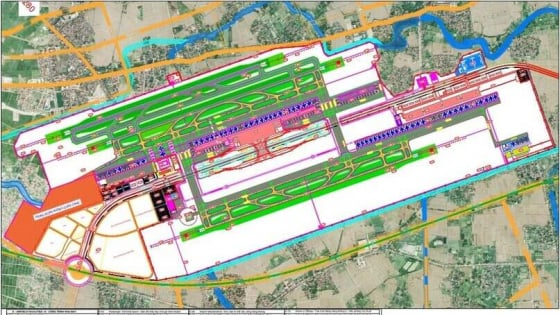
Gia Binh Airport Set to Lead Northern Vietnam’s Skies
Gia Binh International Airport, located in Bac Ninh province and situated within a key industrial hub adjacent to Hanoi, is set to become northern Vietnam’s largest airport following significant adjustments to its projected capacity and land area. These revisions, approved by the construction ministry, mark a monumental shift in the country’s aviation strategy. The airport’s footprint will now expand to a massive 1,960 hectares, which is a sharp increase from the previous April revision of just 408.5 hectares. Its annual passenger handling capacity is expected to soar, reaching approximately 30 million by 2030 and an impressive 50 million by 2050, which are substantial increases from earlier projections of 5 million and 15 million, respectively. With these revised plans, Gia Binh will officially surpass both Hanoi’s Noi Bai International Airport and Ho Chi Minh City’s Tan Son Nhat International Airport, positioning it as the second-largest airport nationwide, only trailing the 5,000-hectare Long Thanh International Airport in Dong Nai province. This ambitious project is estimated to require an investment of around VND120.84 trillion ($4.62 billion) through 2030, with an additional VND61.46 trillion ($2.35 billion) through 2050, and has already commenced construction in December 2024 with a directive from Prime Minister Pham Minh Chinh for an expedited completion.
National Vision for Airport Network Expansion
The expansion of Gia Binh Airport is a cornerstone of a much larger national vision for Vietnam’s airport network. The master plan envisions a total land area of approximately 25,791 hectares dedicated to airport development nationwide through 2030, with a broader objective of expanding the airport network from 22 to 30 by 2030 and further to 33 by 2050. This ambitious project will require an estimated total investment of VND444.71 trillion ($17.01 billion) through 2030, with funding to be mobilized from a combination of state budgets, non-budgetary sources, and other legal funding channels. The plan outlines a strategic network of 14 international gateways and 16 domestic airports by 2030, which includes key international airports like Van Don, Cat Bi, Noi Bai, and the new Long Thanh, as well as a comprehensive list of domestic terminals spread across the country. By 2050, the total network is projected to reach 33 airports, comprising 14 international and 19 domestic terminals, with three new domestic airports planned, all of which will work in concert to support the country’s growing aviation needs.
Strategic Investments to Support Future Growth
This comprehensive national airport development plan signifies Vietnam’s strategic commitment to bolstering its economic and logistical capabilities on a global scale. By expanding its airport network and increasing collective capacity, the country is actively laying the groundwork to support its burgeoning economy, burgeoning tourism industry, and expanding role in the global supply chain. The massive investment in both new and existing infrastructure demonstrates a long-term vision to enhance national connectivity and competitiveness. The decision to dramatically expand Gia Binh Airport in the key industrial hub of Bac Ninh province, in parallel with a downward capacity revision for Noi Bai, is a clear strategic move to de-congest existing hubs and create new, high-capacity gateways that can handle the future demands of passenger and cargo traffic. These forward-looking investments are not merely about building terminals and runways; they are about positioning Vietnam as a major player in Southeast Asia and beyond, equipped with the world-class infrastructure necessary for sustained economic development in the coming decades.