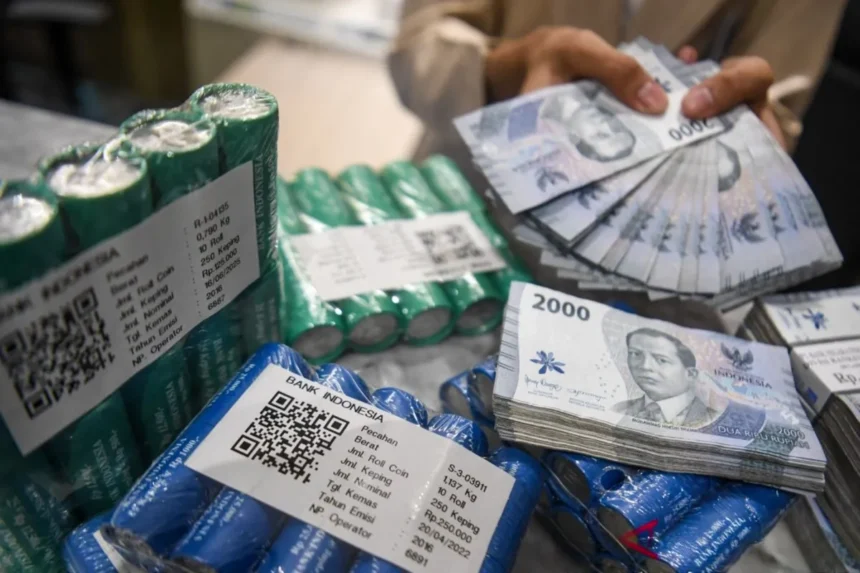
Government Initiates Bill Drafting for Rupiah Redenomination
The Indonesian government has officially commenced the process of drafting a bill concerning the rupiah redenomination, a critical policy change that is strategically planned for completion by 2027.
This proposed legislation, aimed at simplifying the national currency’s structure, is notably included among the Ministry of Finance’s (MoF) key strategic programs for the five-year period spanning 2025 to 2029, as outlined in the comprehensive Finance Minister Regulation No. 70 of 2025.
The official regulation explicitly states, “A bill on Rupiah Rate Change (redenomination) is a carried-over bill planned for completion in 2027,” confirming the government’s renewed commitment to this long-discussed monetary policy.
The core proposal within the bill involves removing three zeroes from the current rupiah denominations, an action that is intended to simplify all financial transactions without, crucially, altering the currency’s fundamental purchasing power.
To illustrate the change, a current Rp1,000 note would be numerically converted to Rp1 after the redenomination takes effect, but the actual value of goods and services—the purchasing power—is designed to remain exactly the same.
The regulation clearly notes that the primary goal of this redenomination is to enhance overall economic efficiency, ultimately aiming to strengthen the country’s economic competitiveness and sustain the existing growth momentum.
This move is also expected to play a vital role in helping stabilize the rupiah’s value in the long term, firmly maintain its purchasing power for consumers, and significantly boost the currency’s credibility both domestically and on the global stage.
Enhancing Credibility and Managing the Transition
The initiative to remove multiple zeroes from the rupiah’s current denomination structure has been a consistent and recurring agenda item for the Indonesian government, with several successive administrations actively preparing plans for this major redenomination policy.
The persistent focus on this reform highlights the perceived economic and psychological benefits of having a simpler currency unit, particularly in terms of international perception and the ease of domestic financial calculations.
The central bank, Bank Indonesia (BI), has previously expressed its readiness to fully support the policy.
Back in 2023, Governor Perry Warjiyo publicly stated that BI was prepared to back the redenomination plan, while simultaneously emphasizing the absolute necessity of cautious execution.
He stressed that the implementation of such a significant monetary policy change must carefully consider the prevailing economic and political stability, as any misstep could lead to market confusion or instability.
This cautious approach is critical because a successful redenomination hinges on public trust and understanding.
Mirroring this conservative outlook, a statement made earlier in 2017 by then–Deputy Governor Mirza Adityaswara suggested that the entire redenomination process, from initial planning to full market transition, could realistically take up to a decade.
He underlined that such a lengthy transition period is necessary and must comprehensively include extensive public education campaigns designed specifically to prevent widespread confusion among the general population regarding the preserved purchasing power of the currency, ensuring the numerical simplification does not mistakenly trigger inflationary fears or pricing disruptions.
The Strategic Mandate and Future Economic Impact
The inclusion of the rupiah redenomination bill within the Ministry of Finance’s strategic programs for 2025–2029 provides a strong governmental mandate and a clear timeline for advancing this complex policy.
The process requires close coordination between the Finance Ministry, which is responsible for the bill’s legislative framework, and Bank Indonesia, which is tasked with the technical execution and market management.
The anticipated benefits—improved economic efficiency and enhanced global credibility—are strategic goals for Indonesia as it seeks to solidify its standing as a major emerging economy.
A currency with fewer digits is generally seen as more stable and manageable in international finance, potentially making it more appealing for cross-border transactions and investments.
Moreover, the domestic impact is expected to simplify accounting practices, reduce the administrative burden associated with handling large numerical values, and ultimately streamline all daily commerce.
While the legislation is slated for completion in 2027, the historical context and the cautious stance of central bank officials suggest that the physical transition, which involves printing new banknotes and coins and phasing out the old ones, will be a multi-year effort that extends well beyond the 2027 legislative target.
The government’s renewed focus on the redenomination indicates a strategic determination to modernize the currency structure and further strengthen the macroeconomic fundamentals needed to support sustained national economic growth over the next decade.