Navigating The Rising Uncertainties Of A Potential AI Bubble In Asia
The global investment landscape at the dawn of 2026 is currently defined by a cautious optimism that is frequently tempered by fears of a burgeoning AI bubble within the technological sector. As Asian equities continue to capitalize on their record-breaking performance from the previous year, market analysts are closely monitoring whether the high-octane growth seen in semiconductor exports can be sustained without a significant price correction.
The deep integration of regional powerhouses like Taiwan and South Korea into the global hardware supply chain means that any sudden shift in sentiment on Wall Street could have immediate and cascading effects across the Pacific. While the underlying profitability of many tech giants remains robust, the sheer concentration of capital into a handful of high-multiple firms has created a vulnerability that few portfolios are prepared to ignore.
Experts suggest that we may be entering a phase of fatigue where the initial excitement over generative models is being replaced by a strict requirement for tangible returns on massive capital expenditures. Despite these concerns, regional information technology indices reached new heights in early January, illustrating a persistent appetite for growth assets among institutional buyers who believe Asian valuations remain more attractive than their North American counterparts.
Technological Sovereignty And Strategic Resilience In The Chinese Market
While the broader region grapples with the global implications of the AI bubble, China is charting a distinctly independent course through its intensified focus on technological self-reliance and domestic semiconductor development. Beijing is currently finalizing a historic seventy billion dollar incentive package designed to insulate its tech ecosystem from external shocks and western export restrictions.
This massive injection of state capital is aimed at achieving seventy percent self-sufficiency in core chip components by the end of the current five-year plan, a goal that has spurred a flurry of high-profile initial public offerings. Recent trading debuts from firms like MetaX and Moore Threads have seen overwhelming demand, indicating that local investors are pivoting away from global tech narratives toward a domestic self-reliance trade.
The appeal of this sector is further bolstered by a significant valuation discount, with key Hong Kong-listed tech gauges trading at multiples far below those of the major western indices. This price discrepancy has created a unique entry point for those seeking exposure to frontier technologies without the extreme premium associated with the global artificial intelligence craze. As Chinese firms continue to integrate sovereign language models, the focus remains on creating an independent hardware and software stack.
Monetary Divergence And The Search For Value In Laggard Markets
The trajectory of Asian equities in 2026 is also being shaped by a stark divergence in central bank policies, which is creating a highly fragmented investment environment across the continent. While the Federal Reserve is expected to initiate a series of rate cuts to support a cooling labor market, regional authorities in Japan and Australia are moving in the opposite direction to combat persistent inflationary pressures.
This policy split is driving a massive rotation of capital into previously underperforming laggard markets that offer better protection from external volatility. India and the Southeast Asian nations are emerging as prime beneficiaries of this shift, as their markets are relatively underweight in the crowded global technology trade. Investors are beginning to find significant value in the defensive qualities of these regions, particularly where government stimulus is prevalent.
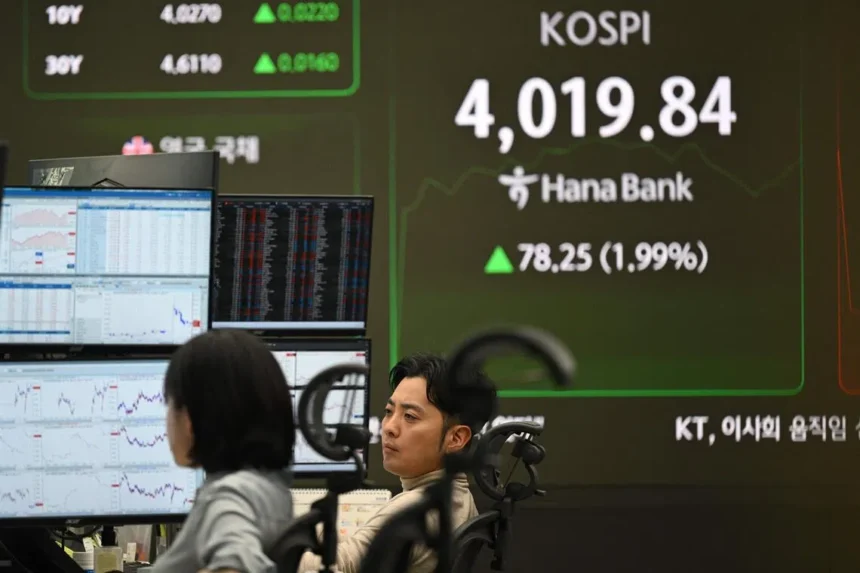
South Korea continues to be a standout performer, fueled not only by its pivotal role in the semiconductor exports boom but also by a rigorous schedule of corporate governance reforms. The benchmark Kospi is marching toward record levels as the government doubles down on efforts to improve transparency and attract long-term foreign capital. By diversifying into these overlooked areas, portfolio managers are successfully hedging against a potential burst in the tech sector while positioning for a broader recovery.
In-Depth Analysis Of Regional Market Dynamics And Capital Reallocation
From a professional financial and analytical perspective, the current market climate in early 2026 indicates a sophisticated restructuring of regional asset allocations in response to the looming threat of an AI bubble. We are observing a significant shift in the risk premium associated with Asian technology hubs, where the historical reliance on US demand is being strategically mitigated through a pivot toward domestic and intra-regional consumption patterns.
This is not merely a tactical move but a fundamental realignment of capital as investors recognize that the cost of entry for global tech exposure has reached levels that may no longer be sustainable. The regional market impact is most visible in the widening spread between hardware-centric economies like Taiwan and the more diversified growth engines of India and ASEAN. As capital exits the crowded semiconductor trade, it is finding a home in the industrial and financial sectors of emerging Southeast Asia.
Furthermore, the divergence in central bank paths is creating a high-volatility environment for currency-sensitive carry trades, particularly involving the Japanese yen and the Indian rupee. Analysts expect that the Bank of Japan’s tightening bias will continue to exert upward pressure on regional yields, potentially creating a headwind for highly leveraged sectors. In contrast, the pro-growth stance of the Reserve Bank of India and Bank Indonesia is likely to foster a favorable environment for domestic mid-cap stocks.
This regional fragmentation means that a top-down index approach is becoming less effective than a targeted, bottom-up selection of quality names with strong balance sheets. The ability of an organization to generate independent cash flow without relying on the speculative tailwinds of the technology craze has become the primary metric for valuation. We anticipate that as the year progresses, the markets demonstrating the highest degree of policy flexibility and earnings resilience will outperform the broader MSCI Asia Pacific Index.