Indonesia Pitches Nuclear Power Investment to the United States
Indonesia recently advanced a compelling pitch for investment opportunities related to the peaceful development of nuclear power to the United States, as senior officials convened for another critical round of tariff talks on the sidelines of the ASEAN Summit in Kuala Lumpur.
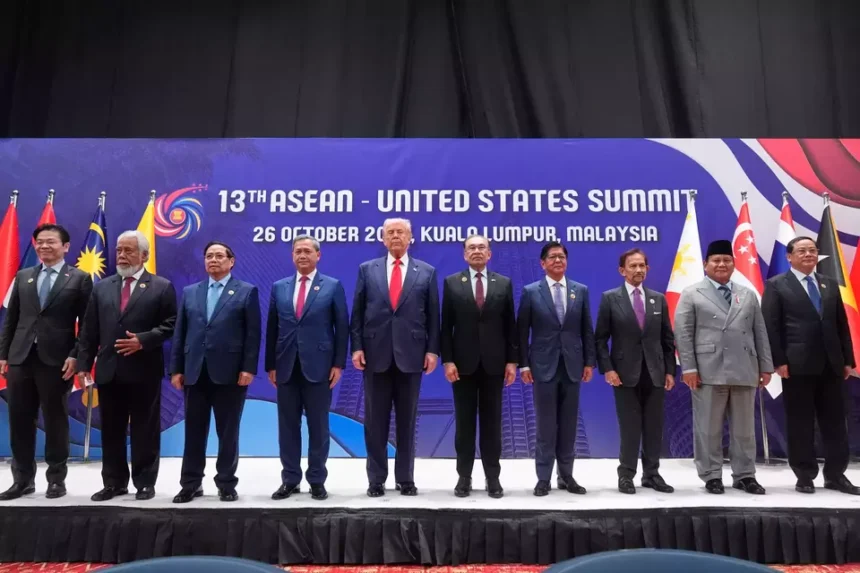
This strategic dialogue took place while both Indonesian President Prabowo Subianto and his American counterpart, Donald Trump, were in the Malaysian capital for the forty seventh ASEAN Summit.
Although President Trump subsequently departed for Japan, his senior economic affairs minister, Airlangga Hartarto, successfully met with the US Under Secretary of State for Economic Growth, Jacob Helberg, in Malaysia to conduct the necessary bilateral talks.
The primary agenda item for the Indonesian delegation was finalizing the highly anticipated agreement concerning the US tariff hikes on Indonesian goods.
Beyond the pressing trade issue, Minister Airlangga utilized the meeting to actively encourage greater investment from Washington into Indonesia, specifically targeting high-tech and high-impact sectors.
Among the key investment areas that Southeast Asia’s largest economy highlighted were high-end semiconductors and the advanced technology of small modular reactors (SMRs), along with emerging fields like artificial intelligence.
Airlangga emphasized the government’s open door policy, stating, “I emphasize that Indonesia is always open to investment opportunities for the US in various strategic sectors that have great potential for collaborative development,” signaling a strong desire for deeper economic and technological partnership with the US in the realm of energy security and clean energy sources like nuclear power.
Advancing Small Modular Reactor Technology in West Kalimantan
The push for US investment in nuclear power through small modular reactors (SMRs) is not an entirely new proposal but rather an acceleration of an existing collaborative effort, marking Indonesia’s serious commitment to diversifying its energy mix.
Although the Indonesian side did not immediately disclose the specific response from Under Secretary Helberg regarding the SMR investment offer, Washington has already been a key partner in helping Indonesia set up its first small reactor, a deal that was originally initiated in early two thousand twenty three.
This partnership saw PLN Indonesia Power, a subsidiary of the state utility firm, signing a technical assistance contract that was supported by a substantial two point three million dollar grant from the US Trade and Development Agency (USTDA) that same year.
This funding is critical for enabling PLN Indonesia to conduct comprehensive feasibility studies on the development of SMR technology, specifically planned for West Kalimantan.
The technology being explored for this project is provided by NuScale, a leading nuclear power company based in Oregon.
Minister Airlangga recently confirmed that Indonesia had already completed the initial feasibility study, signifying significant progress in the nation’s pursuit of cleaner, more reliable energy.
Small modular reactors offer a compelling solution for Indonesia’s archipelagic geography, as they possess approximately one-third of the generating capacity of traditional nuclear power facilities, making them ideal for deployment in remote or smaller areas with limited grid infrastructure, thereby enhancing national energy resilience.
Finalizing Trade Pacts and Strengthening US-ASEAN Relations
The discussions in Kuala Lumpur were intricately tied to Indonesia’s broader efforts to finalize a comprehensive trade pact with the United States, a relationship that has recently seen careful negotiation over trade tariffs.
A significant, preliminary deal was reached in July between President Trump and President Prabowo, which resulted in Washington imposing a lower-than-threatened tariff rate of nineteen percent on a range of Indonesian goods.
In a reciprocal measure, President Prabowo gave his approval for tariff exemptions on certain American products bound for Indonesia.
The Prabowo government is now actively focused on persuading the Trump team to grant tariff exemptions for key Indonesian commodities, such as palm oil, within the final agreement, a critical issue for the nation’s economy.
Minister Airlangga had previously indicated to reporters that Indonesia was aiming to conclude these negotiations by the end of October.
Meanwhile, President Trump’s engagement with the region demonstrated a strong commitment to its security and economic future.
Before his departure for Japan, Trump held a working session with ASEAN leaders, during which he described Southeast Asia as home to “some of America’s most important allies.”
He also specifically thanked President Prabowo for Indonesia’s assistance in his peace efforts in the Middle East, concluding his address by assuring the leaders, “My message to the nations of Southeast Asia is that the US is with you, one hundred percent. We intend to be a strong partner and friend for many generations to come,” cementing the strategic importance of the region to the current US administration.