Export Performance and the Resilient Indonesian Fishery Sector
The Indonesian government remains optimistic about the long-term potential of the domestic fishery sector despite navigating a complex and volatile international trade environment in early 2026. According to the latest data from the Ministry of Marine Affairs and Fisheries, national seafood exports from the beginning of the year until mid-March have reached a total value of approximately US$983.1 million. This significant financial milestone was achieved through the shipment of over 197,718 tons of various marine products before a temporary suspension of cargo transportation occurred on March 13. The Head of the Marine and Fishery Quality Control and Supervision Agency, Ishartini, confirmed that these figures are backed by the rigorous issuance of health certificates, which serve as a primary food safety requirement for 140 global trading partner countries.
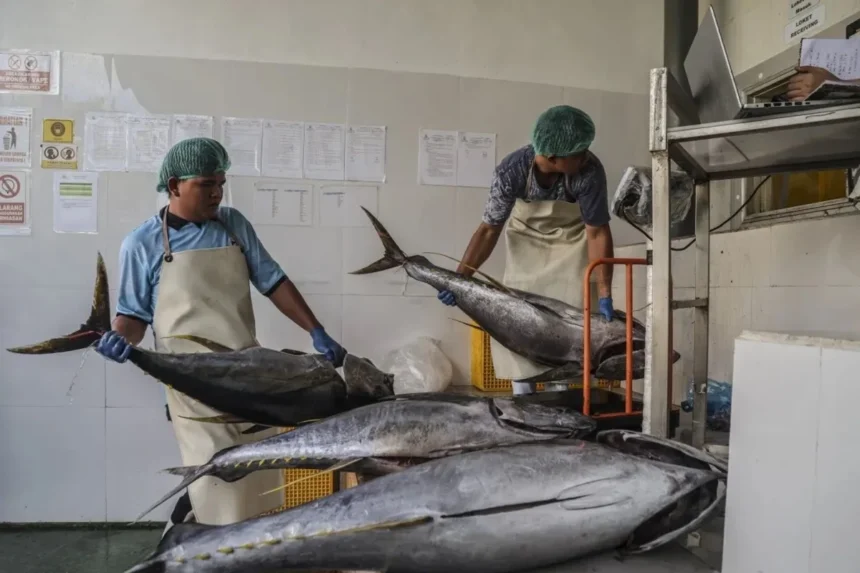
The diversity of the Indonesian fishery portfolio remains its greatest strength, with ten flagship commodities leading the charge in international markets. These include high-demand items such as whiteleg shrimp, tuna, squid, blue swimming crab, and seaweed, alongside skipjack tuna, giant tiger prawns, and octopus. By maintaining strict quality control and ensuring that every shipment meets international sanitary standards, Indonesia continues to position itself as a reliable supplier for major economies including the United States, China, Japan, and several Southeast Asian neighbors. This commitment to excellence ensures that even during periods of logistical uncertainty, the reputation of the nation’s aquatic resources remains untarnished, providing a solid foundation for future growth and sustainable ocean management.
Geopolitical Challenges and Supply Chain Disruptions in Global Trade
While the demand for premium seafood remains consistent, the broader fishery landscape has faced substantial headwinds due to escalating geopolitical tensions in the Middle East. These external conflicts have created a ripple effect across global shipping lanes, leading to a noticeable decline in both export volume and value compared to the same period in the previous year. Specifically, the ministry reported a 41.3% drop in export volume and a 21.7% decrease in total value, highlighting the sensitivity of perishable goods to maritime delays. Ishartini acknowledged that the current fishery supply chain is under immense pressure due to forced changes in shipment routes, which inevitably lead to additional logistics costs and a scarcity of available containers and mother vessels.
These logistical hurdles contribute to higher final product prices, potentially impacting the competitiveness of Indonesian exports on the global stage. Despite these obstacles, the application process for health certificates indicates that international interest in Indonesian marine products has not waived. The challenge lies not in a lack of buyers, but in the physical difficulty of moving goods across borders in an efficient and cost-effective manner. To mitigate these risks, industry stakeholders are closely monitoring the availability of cargo space and exploring alternative transportation methods to ensure that time-sensitive products reach their destinations without compromising quality. The resilience of the sector is being tested, but the underlying health of the industry suggests a rapid recovery once corridors stabilize.
Domestic Absorption Strategies and Future Market Stability
To counter the impact of reduced international shipping capacity, the Ministry of Marine Affairs and Fisheries is proactively encouraging an increase in domestic fishery product absorption. By stimulating local demand, the government aims to provide a safety net for producers and fishermen who may be temporarily unable to access their traditional overseas markets. This strategic shift not only helps to maintain price stability within the country but also enhances national food security by ensuring that high-quality protein sources remain available to the Indonesian population. Furthermore, the ministry is maintaining intensive communication channels with both domestic stakeholders and international partner countries to anticipate and respond to shifts in the global situation.
The long-term vision for the Indonesian fishery industry involves a balanced model where strong export ties are complemented by a robust internal market. By investing in better cold chain infrastructure and domestic distribution networks, the ministry is preparing the industry to be more self-reliant and less susceptible to the whims of global logistics. As trade stability remains a top priority, the focus on transparency and quality assurance will continue to be the primary drivers of success. Through a combination of strategic diplomacy and internal market development, Indonesia is ensuring that its vast maritime resources continue to drive economic growth and provide livelihoods for millions of people across the archipelago, regardless of the challenges presented by the current global landscape.
Macroeconomic Displacement and Institutional Capital Allocation Analysis
The 2026 performance of the Indonesian marine export sector represents a critical inflection point in the Southeast Asian financial landscape, signaling a transition toward more resilient and domestically-anchored trade models. We analyze that the current US$983.1 million export valuation is a testament to a quality over quantity shift, where high value flagship commodities like tuna and whiteleg shrimp are maintaining the nation’s fiscal health even as volume fluctuates. From a professional financial perspective, the 21.71 percent decline in value relative to a 41.35 percent drop in volume suggests strong pricing power for Indonesian aquatic assets. This indicates that global markets are willing to pay a premium for certified, high quality marine proteins, effectively de-risking the sector from the most aggressive impacts of the current logistical crisis.
Furthermore, we project that the government’s move to increase domestic absorption will act as a localized catalyst for a re-valuation of the internal food processing industry. For institutional investors, this pivot creates a unique entry point into cold chain logistics and domestic retail infrastructure, sectors that are now viewed as essential buffers against geopolitical volatility. We observe that the market is already beginning to price in a stability premium for diversified fishery firms that can successfully pivot between international and local demand. The ability of the ministry to maintain health certificate issuance for 140 countries during a period of conflict proves that the institutional framework of the Indonesian maritime sector has reached a level of maturity that is highly attractive to long term capital.
The long term impact on the regional market will manifest as a structural stabilization of the Indonesian project pipeline, as the state gains the financial precision required to protect strategic maritime assets from external price shocks. This transition toward a more resilient and domestically funded development model reduces sovereign risk and provides a more stable environment for equity markets related to the agribusiness and logistics sectors. As corporate governance is strengthened through the alignment of local producer interests with state led initiatives, we expect a narrowing of the risk premium typically associated with emerging market primary industries. The proactive financial stance taken by the ministry today sets a new regional standard for how a resource rich economy can transform global uncertainty into localized stability, ensuring a cohesive and prosperous national economic trajectory through 2027.