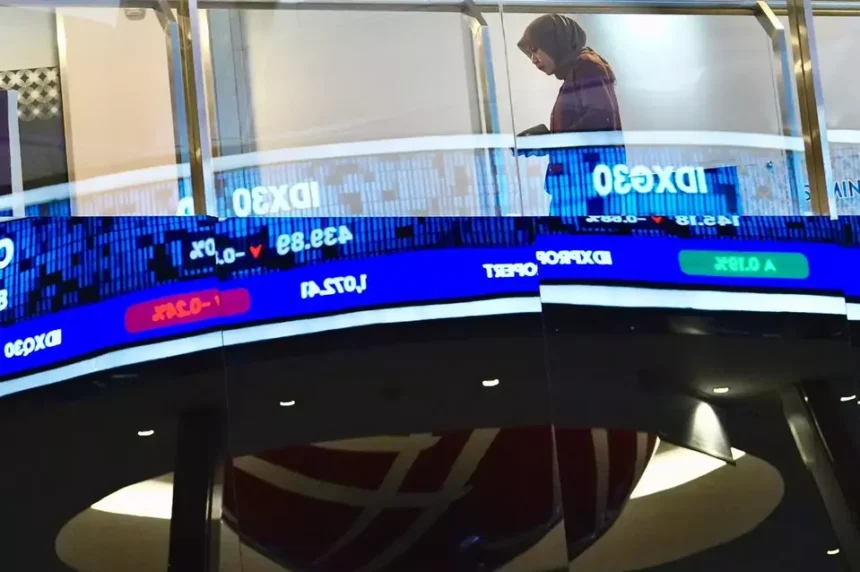
Institutional Resilience And Recent Performance Of The JCI
The Indonesian capital market demonstrated notable stability during the first week of May as the JCI managed to secure a modest weekly gain despite a complex backdrop of global geopolitical tension and fluctuating domestic indicators. The benchmark index remains a focal point for regional investors seeking defensive positions in Southeast Asia. Closing at 6,969.396, the index reflected a 0.18% increase that was bolstered by a significant surge in trading activity and renewed interest from international capital holders.
Market capitalization on the Indonesia Stock Exchange mirrored this positive trend by edging up 0.19% to reach a staggering 12,406 trillion rupiah. What stands out most to technical analysts is the robust increase in average daily transaction values, which climbed over 26.14% to exceed 23 trillion rupiah. This uptick in liquidity suggests that while broader macro concerns persist, the underlying demand for Indonesian equities remains healthy among active traders. Daily trading volumes experienced an even more dramatic rise, surging by over 23% to nearly 46 billion shares.
This heightened frequency of trades indicates a period of intense portfolio rebalancing as participants navigate the transition into the second quarter of 2026. Although cumulative net sales for the year remain in negative territory, the substantial net purchases recorded by foreign investors toward the end of the week provide a glimmer of hope for a sustained recovery in asset valuations. The ability of the local exchange to maintain its composure in the face of external shocks highlights the growing maturity of the domestic investor base and the strategic importance of Jakarta as a regional financial hub.
Navigating Global Geopolitical Turbulence And The JCI Outlook
External factors continue to weigh heavily on investor sentiment, with the JCI sensitive to the shifting dynamics of Middle Eastern security and high level diplomatic negotiations between major world powers. Market participants grew increasingly cautious following reports of naval activity in the Strait of Hormuz, an event that reignited fears of supply chain disruptions and energy price volatility. Despite reassurances from Washington regarding the status of regional ceasefires, the potential for sudden escalations keeps many institutional players on the sidelines.
The brokerage community has noted that these geopolitical risks often lead to tactical shifts toward safe haven assets, occasionally putting pressure on emerging market indices. Furthermore, the global investment community is closely monitoring the upcoming summit in Beijing between the United States and China, which is scheduled for mid May. This meeting is expected to address critical trade and security issues, but the lead up has been marred by a sense of hesitation among officials. Negotiations concerning a proposed framework to revive permanent talks with Tehran are also at the center of the current market narrative.
Sticking points such as nuclear inspection mechanisms and uranium enrichment remain unresolved, leading to a climate of uncertainty that prevents a full scale rally in riskier assets. The outcome of these Pakistan based talks will likely dictate the direction of global capital flows for the remainder of the month. As long as these international tensions remain at the forefront, the performance of the local benchmark will be a reflection of how effectively regional markets can decouple from broader global anxieties. Maintaining a stable trajectory under such pressure is a testament to the fundamental strength of the listed entities within the index.
Domestic Economic Indicators And Future JCI Stability
On the home front, the performance of the JCI is being balanced against a set of challenging domestic economic data that suggests a cooling of internal demand. Indonesia’s foreign exchange reserves saw a decline to $146.2 billion in April, a move largely attributed to the relative weakness of the rupiah against a dominant greenback. This trend has reinforced expectations that the central bank will maintain a cautious and perhaps more hawkish policy stance to protect the national currency and manage inflationary pressures.
Analysts are also concerned about signs of slowing growth in the residential property sector, where price index growth has decelerated compared to previous quarters. Perhaps more telling is the persistent weakness in the automotive sector, with car sales expected to show a continued contraction following a sharp drop in March. These figures highlight a broader trend of cautious consumer spending that contrasts with the resilient activity seen on the stock exchange floor. For the JCI to sustain its current levels, there will need to be a visible recovery in core domestic sectors that drive corporate earnings.
The divergence between equity market performance and real world economic indicators often points to a market that is looking beyond short term hurdles toward a more optimistic long term horizon. As investors digest the implications of slowing demand, the focus remains on high quality blue chip stocks that offer reliable dividends and strong balance sheets. The ability of the exchange to attract nearly 11.42 trillion rupiah in foreign net purchases on a single Friday suggests that professional money managers still see deep value in the Indonesian market despite the prevailing headwinds.
Regional Liquidity And Macroeconomic Resilience
The current behavior of the JCI signals a fundamental decoupling between speculative capital and the underlying real economy. While domestic indicators like automotive sales and property growth show visible contraction, the 26.14% surge in daily transaction value suggests that the Jakarta exchange is effectively acting as a regional liquidity sponge during times of global volatility. This is indicative of a market that has matured beyond simple retail participation into a more sophisticated institutional environment where high frequency trading and foreign inflows provide a floor for valuations even as the rupiah experiences pressure.
The local market impact is further complicated by the tightening of foreign exchange reserves, which restricts Bank Indonesia’s ability to stimulate the economy without risking currency instability. This creates a unique environment where the equity market must rely on its own internal earnings resilience rather than central bank support. However, the concentration of foreign net buys in the closing sessions of the week suggests that international funds are rotating out of high risk energy corridors and into the relative safety of Indonesia’s diversified service and banking sectors. This rotation provides a vital hedge for the national economy against external geopolitical shocks originating in the Middle East.
Ultimately, the 2026 economic landscape for the ASEAN region is defined by this specific tension between global risk and local stability. The JCI current trajectory suggests that Indonesia is successfully positioning itself as a defensive harbor for global capital. While the cooling of consumer demand poses a medium term challenge for growth, the efficiency of the Indonesia Stock Exchange in maintaining high volume and frequency levels indicates that the financial infrastructure is robust. For sophisticated investors, this period of domestic slowdown coupled with equity resilience offers a strategic window to accumulate assets in high value sectors before the anticipated easing of global tensions leads to a broader market breakout.