A Strong Start for the Malaysian Industrial Landscape and Growth
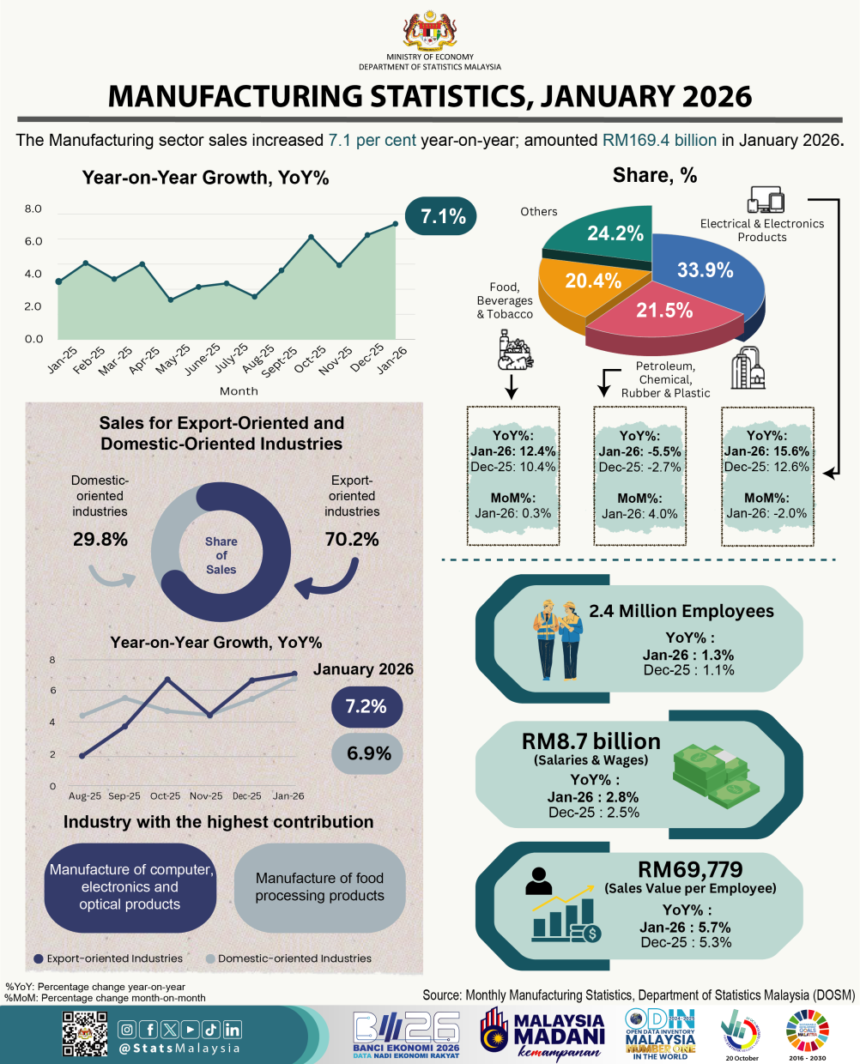
The dawn of 2026 has brought a wave of optimism to the Malaysian economic landscape as the national manufacturing sector’s sales value surged by 7.1 percent year-on-year to reach a staggering RM169.4 billion in January. According to the latest data released by the Department of Statistics Malaysia, this performance marks a noticeable improvement over the 6.4 percent growth recorded in the preceding month of December. Chief Statistician Datuk Seri Dr. Mohd Uzir Mahidin highlighted that this upward trajectory was primarily fueled by the electrical and electronics sub-sector, which demonstrated a robust growth rate of 15.6 percent. This particular segment remains the backbone of the nation’s industrial output, showcasing the resilience of local production lines in meeting global demand.
Beyond electronics, the food, beverages, and tobacco industries, along with non-metallic mineral and basic metal products, provided additional momentum, growing by 12.4 percent and 5.7 percent respectively. When looking at the month-on-month figures, the incremental rise of 0.5 percent suggests a steady and sustainable recovery, rather than a volatile spike. This consistency is vital for maintaining investor confidence and ensuring that the industrial ecosystem can handle the logistical demands of increased output. The data clearly indicates that the primary drivers of this expansion are well-diversified, spanning across both high-tech components and essential consumer goods, which helps insulate the broader economy from sector-specific downturns.
Strategic Expansion Within Export and Domestic Oriented Markets
The internal dynamics of the manufacturing landscape reveal a sophisticated balance between serving international markets and meeting growing domestic needs. Export-oriented industries, which command a lion’s share of approximately 70.2 percent of total sales, saw their performance improve by 7.2 percent in the first month of the year. This surge was heavily influenced by the production of computers, electronics, and optical products, which leaped by 17.9 percent, further cementing Malaysia’s role as a critical hub in the global tech supply chain. Additionally, the production of vegetable and animal oils and fats witnessed a 13 percent increase, proving that the nation’s traditional strengths in commodities continue to yield high returns.
On the domestic front, the local-oriented industries expanded by 6.9 percent, a significant jump from the 5.6 percent recorded previously. This domestic growth was largely underpinned by food processing activities and the fabrication of metal products, which both grew by nearly 6 percent. These figures suggest that internal consumption remains strong, providing a reliable safety net for local producers. The ability of the manufacturing sector to thrive in both export and domestic arenas highlights the versatility of Malaysian firms in navigating different market pressures. By maintaining a two-pronged growth strategy, the nation is effectively leveraging its geographic advantage and its skilled workforce to capture value at every stage of the production cycle.
Workforce Development and Future Economic Resilience Analysis
As the scale of industrial production expands, the human element of the manufacturing sector has also seen positive adjustments, with the total number of employees reaching 2.4 million in January 2026. This represents a 1.3 percent increase in employment, driven by the need for specialized labor in the food and beverage, electronics, and basic metal sub-sectors. While the number of personnel grew, the total salaries and wages paid reached RM8.71 billion, reflecting a 2.8 percent year-on-year expansion. Interestingly, the average salary per employee rose by 1.4 percent, while the sales value per employee grew by 5.7 percent to hit RM69,779.
This disparity suggests an increase in operational efficiency and productivity, where the output per worker is rising faster than the cost of labor. From a macroeconomic perspective, this shift toward higher productivity is essential for long-term sustainability in the B.I.F.E. landscape. We analyze that the continued dominance of the E&E sector acts as a strategic hedge against global volatility, as the world’s reliance on Malaysian-made semiconductors shows no signs of waning. Overall, the synergy between rising sales, a growing workforce, and improved productivity levels positions the industry as the primary engine for Malaysia’s fiscal health throughout 2026 and beyond.
Regional Market Impact and Structural Maturity Analysis
The 7.1 percent surge in Malaysian industrial sales during the initial period of 2026 signifies a profound maturation of the regional B.I.F.E. landscape. We analyze that this performance acts as a vital indicator of shifting capital mobility within Southeast Asia, as multinational firms increasingly designate Malaysia as a high-tech alternative to more volatile neighboring markets. From a professional perspective, the 15.6 percent expansion in the electrical and electronics sub-sector serves as a localized catalyst, reinforcing the national sovereign credit profile by ensuring a consistent stream of foreign exchange earnings. We observe that the record sales value of RM169.4 billion reflects not just a numerical achievement but a deeper structural integration into the global high-value supply chain, particularly within the semiconductor and optical components niches.
Furthermore, we project that the 5.7% increase in sales value per employee will lead to a more resilient national trade balance over the 2026-2030 cycle. The convergence of domestic food processing growth and export-led technological production indicates a successful dual-track strategy to integrate with advanced global standards while insulating the local economy from external shocks. For institutional investors, this creates a unique environment where the domestic market serves as a stable operational base for aggressive international expansion. The transition from labor-intensive assembly toward higher-value automated production represents a definitive structural upgrade for the economy. We conclude that this period marks a critical tipping point where Malaysia is successfully decoupling its industrial growth from simple commodity price cycles, establishing itself as a sophisticated global participant in the high-end industrial arena.