National Aquaculture Potential
Indonesia tries to position itself as a major global leader in blue economy initiatives, with the government aggressively backing advanced shrimp farming operations across multiple maritime provinces. According to statements from the highest echelons of corporate and state leadership, the country is uniquely equipped to leverage its immense geographical advantages to capture substantial shares of the international premium seafood export market. This long-term macroeconomic commitment was recently highlighted during an institutional oversight mission to a state-of-the-art corporate aquaculture complex operating within the Kebumen region, where senior executives and policymakers evaluated modern cultivation methodologies.
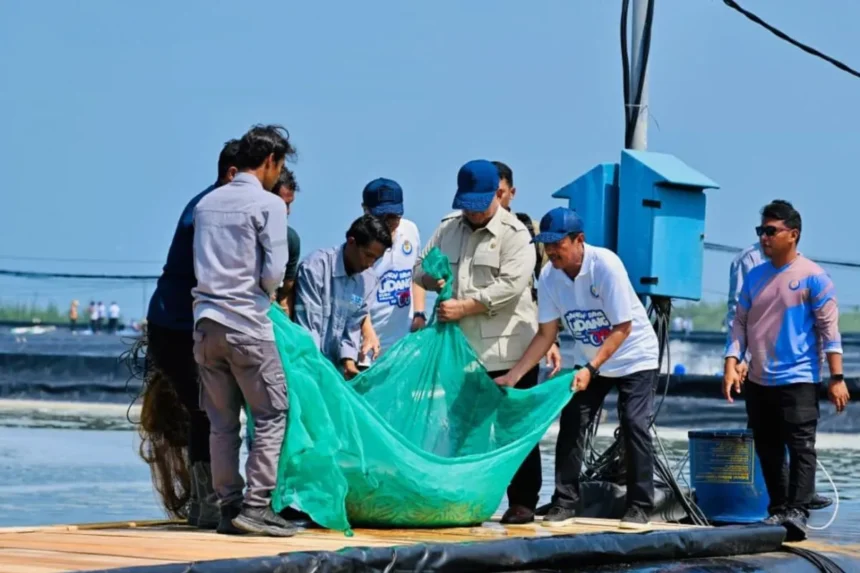
This specialized facility encompasses roughly one hundred hectares of high-density production zone dedicated to the controlled farming of whiteleg vannamei variants, providing an optimal testing ground for scalable industrial practices. Field inspectors directly monitored the automated harvesting protocols and high-velocity post-harvest sorting workflows that ensure product compliance with rigorous international food safety metrics before wholesale market distribution. The head of state reconfirmed that the immense structural capacity found within these regional aquaculture sectors establishes a definitive pathway for the domestic market to permanently outpace competing oceanic trade jurisdictions.
The transition toward high-density automated infrastructure represents a fundamental departure from the traditional, extensive pond cultivation models that have historically limited domestic seafood yields. By standardizing bio-security measures and industrial sorting lines at the municipal level, regional administrators can systematically lower the localized mortality rates associated with cross-contamination and unstable coastal water variables. Over the next decade, this structural integration of advanced agricultural engineering will serve as the primary foundational base for stabilizing the volume and quality of non-oil commodity exports flowing from secondary trading hubs.
Production Economics And Scalability
The underlying financial metrics of the Kebumen production model demonstrate the immense commercial viability of modern shrimp farming systems when supported by structured capital deployment. This massive technical installation incorporates two hundred six separate, bio-secured pond plots that utilize advanced water filtration and real-time biometric monitoring arrays to maximize survival rates. Financial forecasting data reveals that this single operational facility generates a remarkable production valuation of approximately sixty-seven point two billion rupiah per individual cultivation cycle.
Given the rapid biological development of the cultivated species, the facility maintains the capacity to double this output, targeting an annualized production valuation of one hundred thirty-four point four billion rupiah. Beyond generating direct balance sheet growth, this capital-intensive asset functions as a vital socioeconomic stabilizer for neighboring coastal communities by creating hundreds of stable, specialized technical jobs in rural areas. The success of this initial phase serves as a vital blueprint for future state-backed infrastructure projects, proving that technical modernization in aquaculture can simultaneously achieve corporate profitability goals and broader regional wealth distribution.
From a venture capital standpoint, the predictable return on investment manifested by these high-yield pond arrays significantly decompresses the risk profile typically associated with commercial aquaculture lending. Institutional financiers are increasingly viewing these standardized, area-based production clusters as secure collateral bases, which will accelerate the flow of private credit into underserved rural coastal markets. This virtuous capital loop not only upgrades local processing infrastructure but also reduces the long-term dependency of small-scale producers on informal, predatory financing networks.
Macroeconomic Expansion Horizons
Building upon the successful operations established in Central Java, the national administration is actively organizing the deployment of a significantly larger shrimp farming infrastructure project located in Waingapu within East Sumba. This upcoming commercial installation is engineered to operate on a far grander scale, integrating advanced processing hubs directly into the cultivation zone to minimize post-harvest logistical friction. State economic planners classify this systematic expansion of the national shrimp farming network as a core pillar of the country’s broader foreign exchange strategy, specifically aimed at amplifying food export volumes to key consumer nations.
By creating massive production centers in historically underinvested territories, the government successfully opens up new employment pipelines while establishing resilient corporate supply chains that insulate the domestic economy from shifting global market trends. Over the next several fiscal stretches, this coordinated investment in advanced shrimp farming technologies will remain a primary metric for determining the nation’s capacity to convert raw marine territory into a sustainable, multi-billion-dollar trade engine.
The geopolitical implications of establishing East Sumba as a major export node are profound, as it strategically positions the nation to service the rapidly expanding seafood consumption markets across the broader Asia-Pacific region. This geographic decentralization of industrial assets away from traditional industrial zones also balances the national trade footprint, encouraging equity in infrastructure distribution across the eastern archipelagos. Consequently, international shipping lines are projected to evaluate new direct freight routes, further lowering transport overhead for adjacent agricultural sectors.
Regional Trade Re-Hedging And Global Supply Chain Arbitrage
The aggressive institutional scale-up of localized shrimp farming clusters represents a vital counter-cyclical hedge against traditional commodity price volatility in Southeast Asia. Global seafood trade matrices indicate that international premium protein supply chains are undergoing severe climate and regulatory stresses, with historic western hemisphere producers experiencing systemic biological headwinds and rising tariff barriers. By rapidly deploying multi-million-dollar, bio-secured aquaculture zones, the domestic market executes a sophisticated structural arbitrage strategy, stepping in to capture high-value market share across major consumer economies like Japan, the United States, and the European Union.
Furthermore, this systematic optimization of area-based aquaculture infrastructure radically alters the underlying unit economics of the regional primary sector, shifting the nation away from raw material extraction toward high-margin, processed food exports. The concentration of processing, sorting, and freezing capabilities directly within rural production hubs compresses the aggregate cost of goods sold, allowing domestic exporters to maintain superior pricing power even during periods of global freight contraction. Over the multi-year macro cycle, this targeted capital transformation will elevate the sovereign trade profile, shifting international investment perceptions from a risk-volatile agrarian economy to an elite, technology-driven aquaculture powerhouse.