Banking Sector Performance Amid Monetary Shifts And Global Risks
The Thai financial landscape entered a period of cautious transition during the first quarter of the year, as commercial banks grappled with the direct consequences of recent rate cuts on their core earnings. While the overall industry managed to report marginal growth in total net profit, the underlying data reveals a significant pressure on net interest income, which is the primary revenue engine for most traditional lenders.
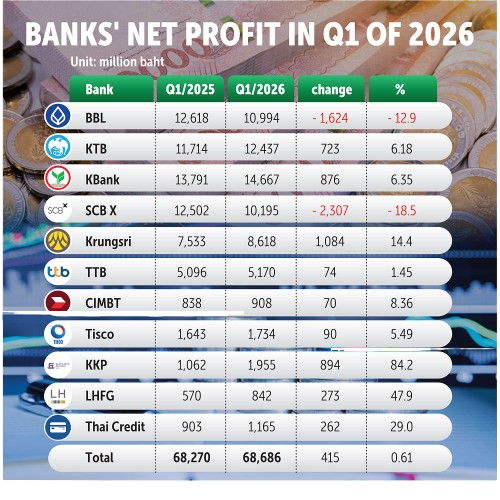
For instance, major institutions like Bangkok Bank and SCB X saw their consolidated net profits decline by double digits as the downward adjustment of policy rates squeezed their interest margins. Specifically, Bangkok Bank reported a 10.9 billion baht profit, a nearly 13% drop that analysts directly attribute to the shrinking spread between deposit costs and loan yields following the central bank’s decision to ease monetary conditions.
This environment of lower yields has forced executive teams to pivot toward non interest income streams to maintain institutional stability. Despite the challenging backdrop of a softer domestic economic outlook, some players like Krungthai Bank managed to find silver linings through robust loan expansion. However, the prevailing sentiment remains one of defensive positioning, as the immediate financial impact of these rate cuts is now being compounded by external factors.
Navigating Geopolitical Volatility And Margin Compression
The emergence of prolonged conflicts in the Middle East has introduced a secondary layer of risk that bank leaders warn could outweigh the mechanical impact of domestic rate cuts in the coming quarters. Chief executives from the nation’s largest lenders have noted that while the first quarter figures do not yet fully reflect the height of these geopolitical tensions, the resulting economic uncertainty poses a grave risk to future operating performance.
Kasikornbank, which posted a net profit of 14.6 billion baht, saw its net interest income fall by nearly 10% despite a surge in non NII categories. This trend suggests that the industry is entering a phase of margin compression where traditional lending becomes less lucrative, necessitating a fundamental shift in business models toward wealth management and fee based services.
The sensitivity of the Thai economy to global energy prices and supply chain disruptions means that any escalation in international conflicts could lead to higher credit loss provisions. As lenders adjust to the reality of lower interest earnings, they must also contend with the potential for rising non performing loans if domestic consumption remains stagnant. The strategic use of liquidity and capital buffers will be essential for institutions to weather this period of high volatility.
Sector Resilience And The Shift Toward Diversified Revenue Streams
Despite the broader downward pressure on interest earnings, the banking sector has demonstrated a notable ability to diversify its revenue sources and maintain capital adequacy. Bank of Ayudhya stood out during the period with a 14.4% rise in net profit, largely fueled by the consolidation of its auto loan subsidiary and a stronger contribution from diversified interest earning assets.
This performance highlights that even in a cycle of rate cuts, banks that can effectively integrate high yield retail segments or specialized financing can still achieve growth. Similarly, TMBThanachart Bank managed a slight uptick in profitability by leaning heavily on its non interest income categories, proving that specialized banking services are becoming a vital hedge against fluctuating monetary policies.
However, the overarching challenge remains the stabilization of the net interest margin, which fell across almost all major institutions. Looking forward, the impact of these rate cuts is expected to linger, influencing how banks price their long term assets and manage their liability structures. Executives remain focused on integrating digital tools to reduce the cost to income ratio, which is seen as a primary defense against top line revenue erosion.
Macro-Financial Strategic Outlook On Regional Yield Compression
The synchronized decline in net interest margins across the Thai banking sector signals a structural shift in the regional credit cycle that demands a reassessment of sovereign risk premiums. We analyze that the aggressive implementation of rate cuts by the Bank of Thailand, while intended to stimulate domestic demand, has created a temporary liquidity trap where commercial lenders are unable to pass on lower costs to borrowers as quickly as their own funding spreads tighten.
This environment is particularly hazardous for the SME lending landscape, which remains the backbone of the Thai economy. We observe that as interest income dwindles, the propensity for banks to tighten credit standards increases, potentially stifling the very economic recovery that the lower rates were designed to support. This paradox is further complicated by the high levels of household debt, which limit the effectiveness of monetary easing as a tool for boosting consumption.
Furthermore, the significant growth in wealth management fees reported by Krungthai Bank and SCB X points toward a deliberate move by the banking sector to capture a larger share of regional capital flows. We analyze this as a strategic pivot toward a capital light model that reduces reliance on the domestic loan book and increases exposure to global financial markets.
This transition is essential for maintaining return on equity levels that satisfy international institutional investors, especially as competition for yield intensifies across the ASEAN region. However, this shift also introduces new operational risks related to market volatility and cross border regulatory compliance. We anticipate that as the banking sector becomes more integrated with global wealth management trends, the focus of national regulators will increasingly move toward managing systemic risks associated with non traditional banking activities.
Ultimately, the ability of Thai financial institutions to navigate this period of rate cuts and geopolitical tension will depend on their agility in rebalancing their asset portfolios. The localized strength of the Thai banking sector, supported by robust Tier 1 capital ratios and high coverage percentages, provides a secure foundation for this transformation. This resilience is a critical factor in ensuring that the nation remains an attractive hub for foreign direct investment, fostering a stable economic environment that can withstand the dual pressures of local monetary easing and global macroeconomic instability.