Indonesia Commits to Expanding Outbound Investment in Africa
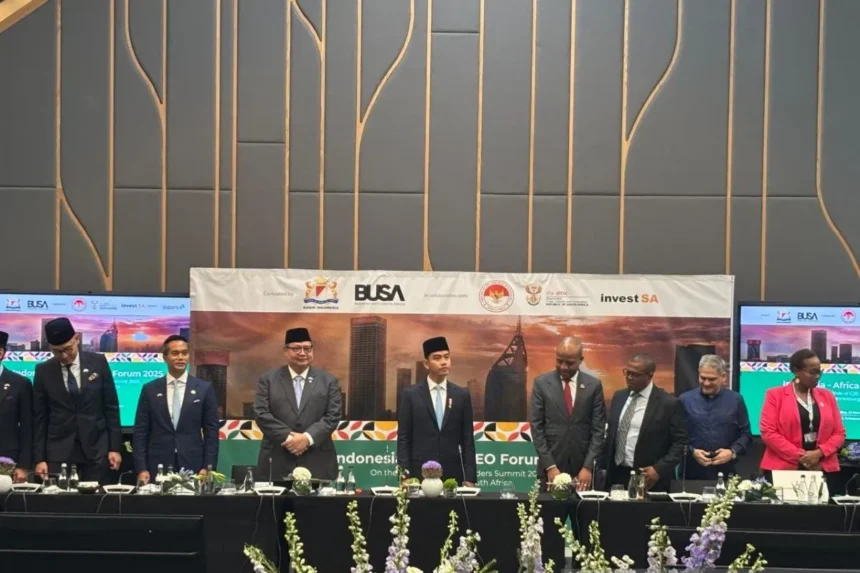
Indonesian Vice President Gibran Rakabuming Raka underscored his nation’s firm commitment to substantially expanding its outbound investment activities in South Africa during the Indonesia-Africa CEO Forum held in Johannesburg on Friday. The Vice President emphasized the strategic importance of this engagement, positioning South Africa not only as a critical bilateral partner but also as an essential gateway for Indonesian businesses seeking to penetrate the wider, rapidly growing African economy market.
This strategic perspective is reciprocated, as Indonesia simultaneously offers considerable value propositions to its African counterparts, including substantial industrial capacity, a large, skilled human resources base, extensive manufacturing networks, technology transfer opportunities, and, crucially, preferential access to the expansive and dynamic ASEAN market. Vice President Gibran was resolute in his message, stating clearly, “I want to emphasize our commitment to improving investment and economic cooperation with Africa. So, if there are any issues, please inform us,” highlighting a proactive approach to addressing potential hurdles in future collaborations.
This statement signals Jakarta’s readiness to actively support Indonesian firms engaging in outbound investment and to ensure the partnership operates smoothly and efficiently. This two-way exchange of resources and market access lays a strong foundation for a collaborative relationship aimed at mutual economy development, where Indonesian capital and industrial expertise can directly contribute to African growth while simultaneously securing new markets for Indonesian goods and services.
The commitment to facilitating this two-way investment flow is paramount to achieving the shared goal of resilient and sustainable global finance growth.
Shaping the Future Through Fair and Inclusive Global Growth
The cooperation forum itself was hailed by Vice President Gibran as a monumental step forward, significantly strengthening the comprehensive relationship and expanding the collaboration potential between Indonesia and South Africa. He articulated a forward-looking vision for emerging economies, stressing that true global prosperity and stability hinge on joint efforts.
“With collaboration, the emerging economies can shape the future,” he asserted, arguing forcefully for a new paradigm in international economy. This vision transcends mere strong growth metrics, demanding that expansion be concurrently “fair and inclusive,” ensuring that the benefits of globalization and international investment are distributed equitably among developing nations.
Indonesia views this partnership not simply as an avenue for outbound investment but as a crucial pillar in establishing a more balanced global financial and trade architecture. The ability of Indonesia to leverage its position as an ASEAN powerhouse to facilitate African market access for its products, and conversely, to attract African business and investment to Southeast Asia, is central to this collaborative finance model.
The focus remains on identifying reciprocal opportunities where Indonesian manufacturing prowess, supported by its committed investment capital, can meet African infrastructure and industrialization needs. Furthermore, the Vice President conveyed warm greetings from Indonesian President Prabowo Subianto, offering deep appreciation to the Government of South Africa for their warm hospitality and excellent organization of the event, reinforcing the high-level political backing for this deepened engagement.
High-Level Delegation Reinforces Strategic Dialogue Ahead of G20
The Indonesia-Africa CEO Forum was initiated and organized by the Indonesian Chamber of Commerce and Industry (Kadin Indonesia), underscoring the strong role of the private sector in driving the nation’s strategic outbound investment agenda and enhancing its global economy footprint. Vice President Gibran was accompanied by a high-profile delegation from the Red and White Cabinet, including Coordinating Minister for Economic Affairs Airlangga Hartarto and Deputy Minister of Foreign Affairs Arrmanatha Nasir.
The presence of these senior officials highlights the government-wide commitment to solidifying finance and investment ties with the African continent. Vice President Gibran’s visit to Johannesburg was scheduled to align with his attendance at the G20 Summit, providing a significant international platform to project Indonesia’s enhanced role.
During the G20 Summit, the Vice President was slated to deliver a major speech, utilizing this global stage to affirm Indonesia’s definitive stance on various priority global economy issues, linking the aspirations of the Indonesia-Africa partnership to the broader global agenda of the G20. The strategic timing of the CEO Forum just before the Summit maximized the diplomatic and business impact of the trip.
By committing to greater outbound investment in Africa and then engaging at the G20, Indonesia effectively bridged regional partnership building with global policymaking, positioning itself as a leader among emerging economies dedicated to fostering fair and inclusive global finance and investment growth.
Market Analysis: De-Risking South-South Investment and Trade Corridors
The commitment to substantially increase Indonesia’s outbound investment in South Africa, positioned as a “gateway,” carries significant implications for regional finance and business flows beyond immediate bilateral ties. This move is strategically aimed at de-risking South-South cooperation by establishing preferential trade and investment corridors independent of traditional Western or Northern financial hubs.
For Indonesian corporations, particularly those in manufacturing, pharmaceuticals, and fast-moving consumer goods (FMCG), leveraging South Africa’s sophisticated financial markets and logistical infrastructure reduces the capital and operational cost barriers of penetrating the wider Southern African Development Community (SADC) market, a major economy bloc.
Furthermore, this investment linkage provides African nations with reliable capital sources and tested industrial expertise from a fellow emerging market, often viewed as more appropriate for developing market conditions than solely relying on developed nation capital. The high-level political backing, evidenced by the attendance of the Cabinet delegation, provides regulatory certainty crucial for large-scale business transactions and infrastructure investment projects.
This commitment essentially transforms the Indonesia-South Africa relationship into a structural foundation for mutual economy resilience, shifting capital flows towards a more multipolar global finance system and enhancing the collective bargaining power of emerging markets within forums like the G20.