Strategic Response To Marine Fuel Volatility And Slow Steaming
Global shipping companies are currently deploying a traditional operational strategy known as slow steaming to combat the financial pressure of soaring marine fuel prices. This tactical reduction in vessel velocity has significantly impacted maritime traffic patterns, contributing to a noticeable decline in the number of ships calling at major regional ports, including Singapore, over recent weeks. While this reduction in vessel speed and frequency might appear beneficial for port operators seeking to manage throughput, the practice of slow steaming presents substantial risks to the broader global economy by potentially disrupting the established flow of international trade.
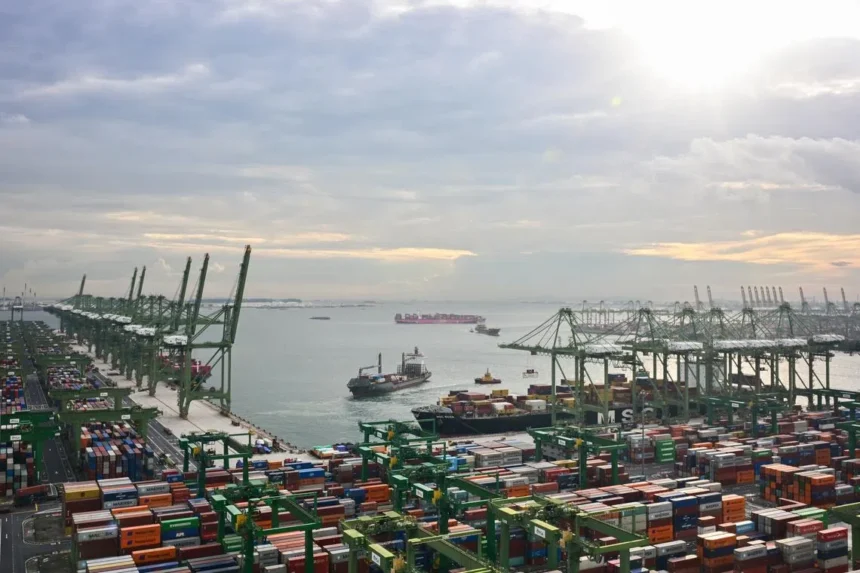
Data from ship trackers indicates that waiting times at Asian ports have eased recently; specifically, Singapore saw waiting times peak at 3.5 days in early March before receding to one day or less. However, this improvement in port congestion is partially offset by extended transit times observed among vessels that have adopted a slower pace to conserve expensive bunker fuel. Reducing a ship’s speed is a direct method to cut fuel consumption, but the resulting increase in journey time places a significant drag on global trade volumes and, consequently, world economic growth.
For export-driven economies like Singapore, which rely heavily on efficient maritime logistics, these delays are particularly impactful as global seaborne trade is projected to decline from its 2025 record high of over US$35 trillion. Despite these evolving geopolitical and economic challenges, PSA Singapore has reported that its port operations remain stable due to proactive planning and close coordination with shipping partners. The port operator emphasized that it has not experienced terminal congestion even with strong container volumes, handling 11.2 million TEUs from January to March 2026, which marks a 6.4% increase year on year.
Economic Implications Of High Bunker Prices And Industry Adaptation
The fundamental driver behind the recent shift toward fewer vessel calls is the high price of marine fuel, commonly referred to within the shipping industry as bunker. Although prices have retreated slightly from their most extreme peaks, they remain at historically elevated levels that necessitate aggressive cost-saving measures like slow steaming. For instance, the price of very low sulphur fuel oil in Singapore hit a staggering US$1,450 per metric tonne on March 9, representing a 182% increase from late February prices.
Even as prices dropped below the US$1,000 mark more recently, they remain significantly higher than pre-conflict levels, forcing shippers to seek ways to shield themselves from their single largest operational expense. High-sulphur fuel oil followed a similar trajectory, peaking at US$1,200 per metric tonne before settling near US$700. While shippers often attempt to recover these costs through bunker surcharges, the industry faces limitations as customers generally refuse to pay for blank sailings or inefficient routes.
The widespread adoption of slow steaming across the global fleet has the potential to severely disrupt the global supply chain, a concern echoed by the International Monetary Fund. The IMF has predicted that global trade volume will grow by only 2.8% in 2026, a sharp decline from the 5.1% advance seen the previous year, while global GDP is estimated to slow to 3.1%. This deceleration is partly attributed to the logistical friction caused by reduced vessel speeds, a tactic that has been used intermittently since the 2008 financial crisis and more recently to offset the costs of compliant fuels under the International Maritime Organization’s mandates.
Operational Challenges And The Path To Supply Chain Recovery
The technical reality of slow steaming suggests that if ultra-large container vessels were to halve their maximum speed from 30 knots to 15 knots, it could add up to 15 days to a typical voyage from Asia to Europe. Paradoxically, these longer transit times can actually improve the bottom lines of shipping companies by effectively reducing available vessel capacity and driving up freight costs. On average, ocean freight costs have climbed by approximately 20% since the start of the Middle East conflict, with essential goods like crude oil, chemicals, and food products seeing even higher rate spikes.
Even if geopolitical tensions ease and critical waterways like the Strait of Hormuz reopen fully, the resulting backlog of stranded ships could take weeks to clear. Experts estimate that for every single day of disruption, it takes roughly three days for the various transport services to catch up, meaning the current nine-week disruption could require 27 weeks to return to normal. In Singapore, while the port is well-equipped to handle high volumes, some supply chain firms estimate that yard utilization has already reached 80% to 90%.
The situation remains more severe in China, where container pileups are causing significant operational issues at major export ports. Compounding these logistics hurdles is the extensive infrastructure damage to oil and gas fields, which the International Energy Agency warns could take months or even years to fully repair. The IEA has highlighted that about 13 million barrels of oil supply have been halted daily due to conflict, describing it as the biggest supply disruption in history. Until energy production and maritime infrastructure are restored, the industry will likely continue to rely on slow steaming as a vital, albeit disruptive, financial defense mechanism.
Market Impact Analysis On Regional Shipping Dynamics
The systemic integration of slow steaming as a fiscal hedge is currently reshaping the ASEAN maritime landscape, particularly for the Singapore hub. From a regional investment perspective, the 182% surge in VLSFO prices has transformed bunker management from a routine operational line item into a primary driver of equity valuation for logistics firms. We observe that as shipping lines prioritize fuel conservation over schedule integrity, the regional economy faces a structural inflationary threat. This is especially evident in the 20% average increase in freight costs, which acts as a regressive tax on the manufacturing sectors across Malaysia and Indonesia that rely on the Singapore transshipment nexus.
The current yard utilization of 80% to 90% in Singapore suggests that while terminal operations remain stable, the system is operating at the edge of its efficient frontier. Financial analysts should note that any further prolongation of the Hormuz disruption will likely trigger a secondary liquidity crisis for smaller regional shippers who cannot easily pass on surcharges. We anticipate a period of consolidation within the ASEAN maritime sector, as larger entities with superior capital reserves leverage slow steaming to squeeze the margins of less efficient competitors. This maneuver effectively converts a logistical delay into a market share acquisition strategy by artificially tightening supply.
Looking forward, the IEA warning regarding a two year supply recovery horizon implies that fuel volatility will remain a permanent feature of the shipping landscape through 2028. This long term high cost environment is expected to accelerate regional investments in alternative energy bunkering, such as LNG and green ammonia, to bypass the traditional petroleum price traps. For institutional investors, the maritime sector now presents a bifurcated risk profile where the ability to manage transit time elasticity is just as critical as fleet size. The successful navigation of this 27 week recovery cycle will define the regional trade leaders for the remainder of the decade.