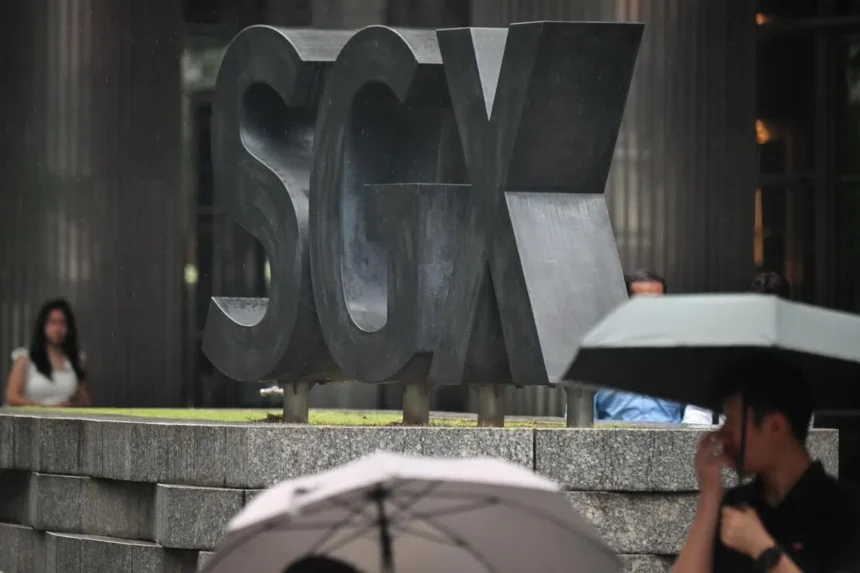
Singapore’s STI Climbs 0.2% on November 27, Mirroring Regional Market Gains
Singapore stocks concluded the trading day on November 27 with gains, effectively tracking the generally positive momentum observed across the wider Asian region, signaling robust market confidence. The benchmark Straits Times Index (STI) achieved a notable rise, advancing by 0.2 per cent or 7.78 points to finalize the trading session at 4,509.34.
This performance indicates stability and positive sentiment in Singapore’s primary equity market, even as other segments showed mixed results. In contrast to the main index’s climb, the iEdge Singapore Next 50 Index, which tracks the performance of the next-largest 50 stocks, experienced a slight dip, inching down by 0.68 points or 0.05 per cent to close at 1,444.74.
Analyzing the broader market activity, the number of successful gainers ultimately surpassed the number of losers, with a ratio of 270 winning stocks against 216 falling stocks. Market liquidity remained strong, with approximately 1.2 billion securities changing hands, totaling a substantial value of $1.2 billion traded throughout the session.
The positive regional backdrop provided crucial support, as key indexes elsewhere in Asia were predominantly in positive territory. Hong Kong’s Hang Seng Index gained 0.1 per cent, Japan’s Nikkei 225 jumped significantly by 1.2 per cent, and South Korea’s Kospi closed 0.7 per cent higher.
The only major outlier was the FTSE Bursa Malaysia KLCI, which shed 0.4 per cent, suggesting localized pressure in Kuala Lumpur contrasting with the broader regional upswing that propelled the STI.
Wall Street’s Influence and Anticipation of a Dovish US Fed Shift
The positive performance of the STI and other Asian markets was strongly influenced by encouraging signals emanating from overnight trading on Wall Street, specifically concerning shifts in anticipated US monetary policy. Mr. Stephen Innes, managing partner at SPI Asset Management, highlighted that US stocks had just logged their best four-day stretch since May, injecting a significant dose of optimism into global risk assets.
This bullish sentiment is primarily driven by investors positioning themselves in anticipation of a new US Federal Reserve chairman, a change widely expected to usher in a new era of monetary policy. This anticipated new leadership is predicted to bring about “faster cuts, a lower neutral rate,” and a foundational “growth-first, inflation-second” world view.
Such a pivot by the Fed would dramatically alter the global Finance landscape, making capital cheaper and more accessible, which is highly beneficial for equity markets. Mr. Innes characterized this policy shift as providing “oxygen for risk assets,” a crucial element for sustained market growth.
He specifically pointed out the disproportionate benefit to sectors like the AI (artificial intelligence) complex, which thrives on inexpensive capital, likened to “drinking cheap capital like it’s running a marathon in July.” This expectation of an accommodative US Fed environment often translates into stronger foreign Investment flows into emerging and developed Asian markets like Singapore, providing an external pillar of support for the STI and its constituent stocks, sustaining the positive trading environment observed in the Asia-Pacific region.
Mixed Performance Across STI Constituents Reflects Stock-Specific Dynamics
While the overall STI finished the day in positive territory, a detailed examination of its constituent stocks reveals a mixed performance that underscores the importance of company-specific news and dynamics over broad index trends. Within the STI, DFI Retail Group stood out as the top gainer, recording a significant rise of 1.5 per cent or five US cents to close at US$3.44.
This strong move suggests positive company news, sector rotation, or bullish analyst coverage specifically targeting the retail sector within the Singapore market. Conversely, the worst performer among the index’s components was UOL, a prominent property and hospitality group, which experienced a noticeable decline, falling by 1.4 per cent or 12 cents to close at $8.47, indicating stock-specific challenges or profit-taking activities.
The performance of Singapore’s highly influential three local banks—DBS Bank, OCBC Bank, and UOB—which collectively wield significant influence over the STI’s direction, also ended the trading session mixed on November 27. DBS Bank showed strength, rising by 0.3 per cent or 16 cents to reach $54.00, and OCBC Bank also posted a gain, up 0.2 per cent or four cents at $18.27.
However, UOB ended the session slightly lower, finishing 0.1 per cent or three cents down at $33.89. This divergence among the major Finance institutions suggests that while the sector remains fundamentally strong, specific Business outlooks or investor rotations are causing variations in individual stock performance, providing a nuanced picture beneath the aggregate STI gain.
Financial Analyst Commentary: The STI’s Function as a Defensive Regional Capital Hub
The STI’s moderate gain on November 27, despite the powerful external stimuli from anticipated Fed policy shifts, reinforces its structural role as a defensive regional capital hub rather than a high-beta growth market. While high-beta Asian markets like the Kospi and Nikkei reacted strongly to the “cheap capital” thesis, the STI’s measured 0.2% rise, dominated by the conservative, mixed performance of its banking (DBS, OCBC, UOB) and property constituents (UOL), highlights its characteristic low-volatility profile.
This stability is a feature, not a bug, making Singapore a preferred destination for institutional Investment seeking stable yield and robust governance in the ASEAN region, particularly as a counterweight to the higher regulatory and political risks present in neighboring markets. The anticipation of a dovish Fed, which signals a peak in global interest rates, is disproportionately beneficial to the local banking sector’s Finance fundamentals, as it reduces funding costs and improves the valuation of long-duration assets held by these institutions.
Conversely, the decline in UOL reflects the sensitivity of the Singapore property sector to domestic cooling measures and high domestic interest rates, which often lags the optimism driven by global macro trends, demonstrating a localized drag on the overall Economy. Ultimately, the STI functions as a highly liquid and geographically central conduit for global capital seeking stability and yield in Asia, making its performance less about aggressive growth and more about reliably capturing regional Business and Finance flows under a favorable macro environment.