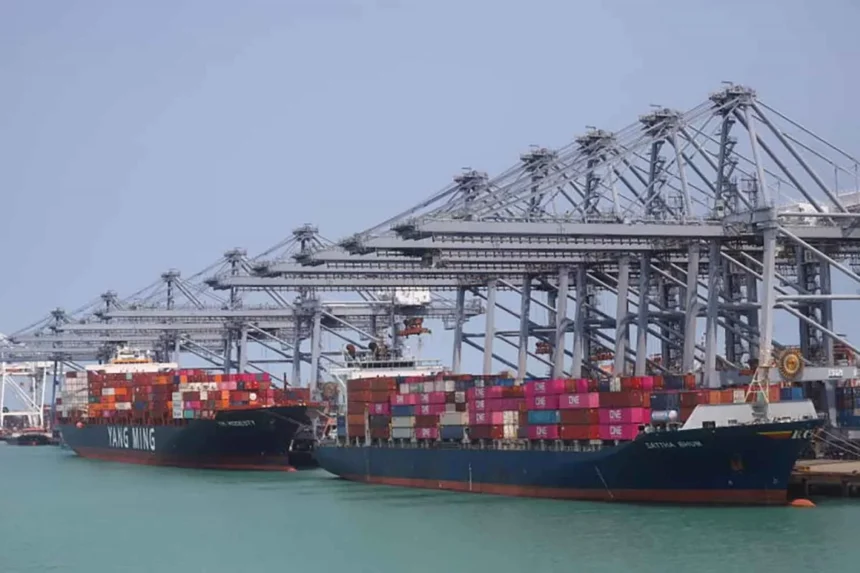
Strong Global Demand Drives Thailand Export Growth Beyond Initial Target
The Ministry of Commerce in Thailand has significantly raised its growth forecast, now estimating that Thailand export value will expand by a robust nine point four to ten point four percent this year, a revision driven by clearer US tariff policies, a strengthening global economic recovery, and soaring international demand for digital technology products, agricultural goods, and food.
Nantapong Chiralerspong, the Director-General of the Ministry of Commerce’s Trade Policy and Strategy Office, highlighted the momentum by reporting that exports surged by an impressive nineteen percent year-on-year in September, reaching US$30.9 billion.
This achievement marks the fifteenth consecutive month of growth and represents the highest single-month rate of expansion since April two thousand twenty three.
During the same period, imports also showed substantial growth, tallying $29.6 billion, a seventeen-point-two percent year-on-year increase.
The positive trend is evident in the cumulative figures for the first nine months of this year, where total exports grew by thirteen point nine percent to $254.1 billion, slightly lagging imports which rose by eleven point nine percent to $254.5 billion.
The revised projection stands as a major success, significantly surpassing the initial, more conservative export target of just two to three percent growth.
The value of this year’s total exports is now projected to reach approximately $329.1 to $332.1 billion, which would establish a new record high for the nation’s trade performance, underscoring the strong global appetite for Thai products.
Industrial Sector Leads Export Surge Amid Diverse Product Demand
The surge in Thailand’s overall export performance is largely attributed to the exceptional growth recorded within the industrial products sector, which experienced a remarkable twenty six percent jump in September.
This industrial growth was broadly spread across various key product categories, demonstrating the diversity and resilience of the nation’s manufacturing base.
Products showing particularly strong growth included computers, peripherals, and parts; automotives, accessories, and parts; gems and jewelry, excluding gold; phones and peripherals; specialized machinery and components; and electrical transformers and parts.
Cumulatively, industrial product exports increased by eighteen point six percent in the first nine months of the year.
Although the agricultural and agro-industrial products segment saw an eight point one percent decline in September, certain agricultural sub-sectors still registered growth, including processed chicken; vegetable and animal oil and fat; wheat products and prepared foods; sugar; and chilled and frozen shrimp, contributing to a marginal zero point six percent growth in this sector for the first nine months.
Looking ahead, export growth is expected to maintain its trajectory in the final quarter.
This continued momentum is being sustained by the recent clarity regarding US tariffs, which has substantially reduced market uncertainty and concern among exporters.
Mr. Nantapong noted that Thailand remains highly competitive in this new environment, particularly with the nineteen percent reciprocal tariff agreement, allowing Thai products to continue flowing efficiently to one of the world’s largest consumer bases.
Monitoring Global Risks to Maintain Economic Momentum
While the outlook for Thailand export remains overwhelmingly positive, with monthly averages expected to settle between $25 to $26 billion for the remainder of the year, several risk factors on the global and regional stage necessitate continuous monitoring by Thai trade officials.
Among the primary concerns are potential trade retaliatory measures that could escalate between the United States and China.
Such actions have the potential to disrupt global supply chains and dampen international trade sentiment, indirectly affecting Thai manufacturers and exporters.
Another immediate risk factor is the possible effects of a prolonged US government shutdown, which could destabilize economic activity in a major trading partner and reduce consumer confidence.
On the domestic and regional front, the appreciation of the Thai baht currency poses a challenge, as a stronger baht makes Thai exports relatively more expensive on the global market, potentially eroding the price competitiveness gained through efficiency.
Furthermore, developments related to the Thailand–Cambodia border situation, despite the recent signing of a peace agreement, require careful observation to ensure regional stability does not become a variable impacting logistics and cross-border trade flows.
The Ministry of Commerce understands that managing these external and financial risks is crucial for converting the current strong momentum into sustainable, record-breaking annual export value and for solidifying Thailand’s position in the recovering global economy.