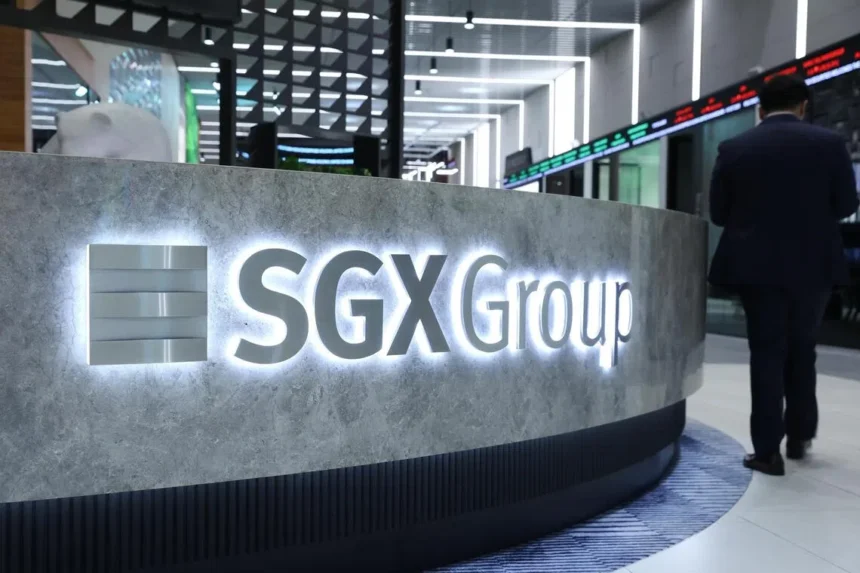
SGX Expands International Access with Three New SDRs
The Singapore Exchange (SGX) significantly expanded its offerings on November 12 by listing three new Singapore Depository Receipts (SDRs): Laopu Gold, Trip.com, and Baidu.
This strategic addition elevates the total SDRs shelf on the local bourse to a remarkable 29 securities.
This total portfolio now includes 10 Thai-listed SDRs, 16 Hong Kong-listed SDRs, and three Indonesian-listed SDRs, showcasing a robust cross-border investment ecosystem.
The introduction of these new SDRs is part of the SGX’s ongoing effort to simplify access to overseas-listed companies for local investors.
SDRs are not actual shares but function as a type of investment product that represents an interest in a stock or security listed on an overseas exchange.
They can be conveniently bought and sold just like traditional Singapore shares through existing local brokers during standard local trading hours.
Crucially, as they are priced in Singapore dollars, SDRs effectively remove the complexities associated with cross-border trading, making international investing more accessible.
Furthermore, they enhance portfolio construction versatility by offering low minimum investment amounts, all under $1,000, catering to a broad base of retail investors.
For the newly listed securities, the minimum trading size for the Laopu Gold SDR on SGX is $270, Baidu is $150, and Trip.com is $170, keeping them highly accessible.
Spotlight on New SDRs: High-Growth Profiles and Strong Returns
The three newly launched SDRs each represent companies with compelling growth narratives and strong financial momentum, drawing significant investor interest.
Laopu Gold, a high-end Chinese jeweler, has recently captured substantial attention, particularly following its successful international expansion.
Its overseas revenue saw an explosive growth of 455 per cent, and the company’s year-to-date returns for 2025 stood at approximately 161 per cent, reflecting its strong market performance.
A key marker of its global success was the opening of its first boutique at Singapore’s Marina Bay Sands.
Meanwhile, Trip.com, a major online travel agency, reported robust financial results for the third quarter of 2025, with net revenue climbing 16 per cent year-on-year to 14.8 billion yuan (S$2.7 billion).
This growth was driven by strong performance across all its business segments.
The company’s 2025 year-to-date returns were about 5 per cent, and earlier in the year, it further signaled investor confidence by announcing a new US$5 billion share buyback program.
Baidu, the Chinese Internet giant, also presented a strong case for its SDRs listing, recording year-to-date returns of around 45 per cent.
Its artificial intelligence (AI) cloud revenue showed exceptional growth, increasing 27 per cent year-on-year to 6.5 billion yuan.
Furthermore, Baidu’s non-online marketing revenue surpassed the 10 billion yuan mark for the first time in 2025, marking a significant 34 per cent year-on-year rise.
These impressive metrics across the new SDRs clearly highlight the SGX’s focus on bringing high-potential international stocks to its local investors, thereby diversifying the opportunities available on the exchange.
SDR Trading Activity Skyrockets Driven by Retail Inflows
The overall trading activity and popularity of SDRs on the Singapore Exchange have seen a dramatic surge, underscoring the successful execution of the cross-border initiative.
The daily turnover for all SDRs hit an impressive $16 million in September, a figure that is over 30 times higher compared to the same period in the previous year, as indicated by SGX data.
This explosive growth was largely fueled by “sustained growth” following the successful launch of Hong Kong SDRs in October 2024.
Prior launches also performed exceptionally well; for instance, Hong Kong-listed CATL and Pop Mart, which launched on August 25, were highly received by investors, with both securities collectively contributing to 20 per cent of the daily turnover values on certain trading days.
The interest in Thai-listed SDRs has also dramatically increased, with retail activities in the third quarter of this year more than doubling year-on-year.
Trading interest in these Thai SDRs was predominantly concentrated in the banking and technology sectors, reflecting specific investor confidence in those segments of the Thai market.
The success is further demonstrated by the total SDR assets under management crossing $220 million in October, a milestone driven by a wave of strong retail inflows.
This significant capital accumulation confirms that the simplified structure and cross-border access provided by SDRs have been strongly embraced by the local investment community, positioning the SGX as a key gateway to regional and international stocks.
Analytical Impact: SGX’s Strategy in Regional Financial Competition
The expansion of the SDR shelf is not merely a product launch; it represents a decisive strategic move by the SGX to solidify its position as the premier financial gateway for capital flows into and out of Southeast Asia and Greater China.
The remarkable 30x year-on-year surge in SDR daily turnover and the cross of $220 million in assets under management validate the liquidity and demand for simplified cross-border products, particularly from retail investors seeking diversification beyond the local market.
By onboarding high-growth names like Laopu Gold (consumer), Trip.com (travel/recovery), and Baidu (AI/tech), the SGX is leveraging the high-growth potential of Chinese companies to inject momentum into its own exchange, a direct competitive response to the Hong Kong Stock Exchange’s (HKEX) dominance in this area.
Furthermore, the inclusion of Thai and Indonesian SDRs creates a robust ASEAN-China bridge, providing institutional and retail funds a cost-effective, Singapore-dollar-denominated mechanism to participate in the region’s most dynamic sectors without incurring the complexities of multiple foreign settlement systems.
This initiative is crucial for the SGX’s long-term sustainability, transforming its role from a primary listing venue to an efficient, highly liquid access point for regional exposure, thereby enhancing Singapore’s overall function as a central Asian financial hub in a period of intense geopolitical and market competition.