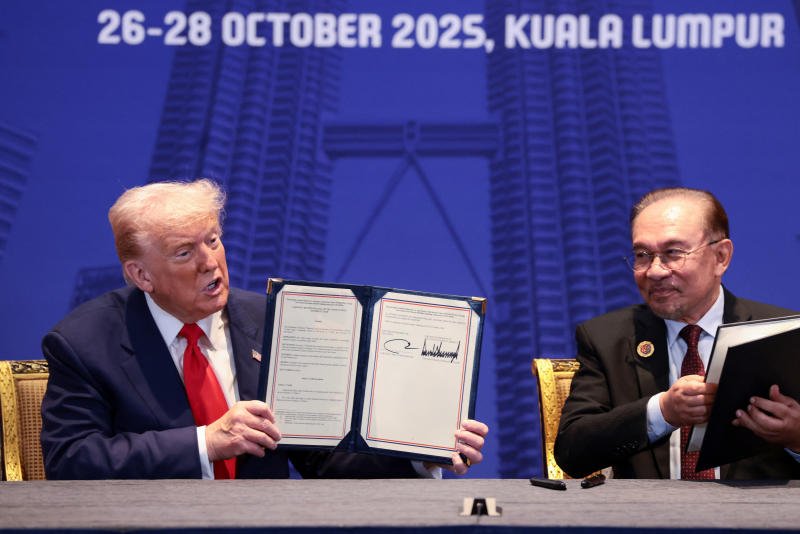
President Trump Secures Key Trade and Critical Minerals Pact with Malaysia
President Trump and Malaysian Prime Minister Anwar Ibrahim formalized a significant new trade agreement and a critical minerals pact on Sunday, a major step as the United States leader actively works to boost trade across Southeast Asia and, simultaneously, address China’s strategy of tightening global access to rare earth elements.
The signing, which took place in the Malaysian capital of Kuala Lumpur, marks a substantial diplomatic and economic milestone.
US Trade Representative Jamieson Greer highlighted the reciprocal benefits of the new arrangement, stating that Malaysia has committed to modifying its tariffs and non-tariff barriers, which the US expects will lead to a substantial increase in overall trade.
Greer specifically anticipated that key sectors such as agriculture, technology, and services would be the primary beneficiaries of this comprehensive agreement.
Furthermore, the critical minerals deal is strategically designed to enhance the resilience of global supply chains for rare earths by ensuring that trade and investment in these vital materials remain “as free as possible and resilient as possible.”
Prime Minister Anwar Ibrahim lauded the newly signed deals, calling them a “significant milestone” that promises to elevate the entire relationship between the two nations well beyond just commercial exchange, underscoring the political importance of this new chapter in US-Malaysia relations under the administration of President Trump.
Leveraging Trade Agreements as a Central Tool for Diplomacy
The formalization of the Malaysian trade agreement is a clear example of how the administration of President Trump has utilized tariffs and trade policy as a central diplomatic tool during his second term in office.
Dan Kritenbrink, a partner at the Asia Group and former US assistant secretary of state for East Asian and Pacific affairs, noted that the Malaysian deal is likely to be used to encourage and apply pressure for other trade agreements across the region, setting a new benchmark for US engagement.
This strategy was also visibly employed earlier on the same day when Trump participated in a signing ceremony between Thailand and Cambodia.
That particular event focused on de-escalating a recent border clash that had tragically resulted in dozens of casualties.
The brief but deadly conflict earlier this year had been brought to a halt after Trump intervened, threatening to scuttle existing trade deals with both countries.
In addition to a critical minerals pact with Thailand—mostly an aspirational pledge—Trump also announced a broad trade agreement with Cambodia.
The Cambodia deal is significant as it exempts hundreds of types of goods from the reciprocal tariff rate on exports that Trump had imposed earlier this year, demonstrating the direct link between trade concessions and diplomatic leverage in the administration’s foreign policy.
Easing Trade Tensions and Securing Critical Supply Chains
The newly inked deal with Malaysia is particularly vital as it is set to ease considerable concerns surrounding Malaysian exports to the world’s largest economy.
This comes after Trump had imposed a 19 percent tariff on the country in August, a rate that was nonetheless lower than the 25 percent he had initially threatened in July.
The volume of trade between the two countries is substantial, having totaled nearly 87 billion last year, according to the US Trade Representative.
The majority of this exchange was in goods, where the US held a deficit of 25 billion, balanced by a surplus of 1.7 billion in services.
For months, Malaysia had been actively seeking less onerous US trade conditions, especially as it grapples with its role in global technology supply chains.
In a related diplomatic effort, Malaysia has promised to intensify its crackdown on the smuggling of advanced semiconductors through its borders destined for China.
Trade Minister Zafrul Aziz confirmed that Malaysia is also negotiating separately to be completely spared from US tariffs on its semiconductor imports, given that the US is its third-largest market for chips.
Despite these trade tensions, Malaysia’s economy showed resilience, expanding by 5.2 percent in the third quarter, surpassing analyst expectations, though the government anticipates a slight growth slowdown to 4.0 to 4.5 percent next year.