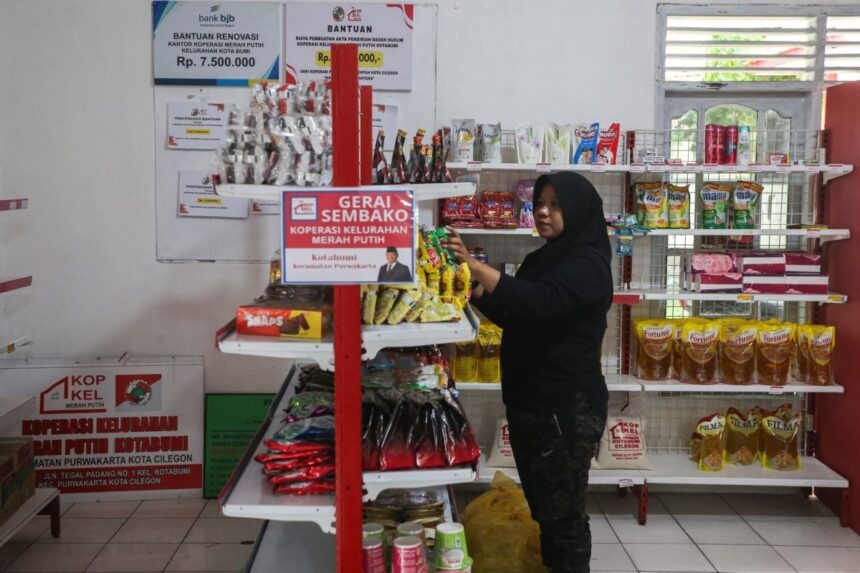
Himbara Banks to Maintain Selective Approach to Village Cooperative Financing
State-owned lenders consolidated under the Himbara group are expected to maintain a selective and cautious approach when it comes to financing the government’s ambitious Merah Putih Village and Urban Cooperatives (Kopdes/Kel) program, even with a government guarantee bolstered by village funds.
This assessment comes from financial analyst M. Rizal Taufikurahman, who serves as the head of the Center for Macroeconomics and Finance at Indef.
Rizal noted that the government guarantee acts primarily as a psychological “confidence trigger” rather than a definitive “determinant of success” for the village cooperative financing initiative.
The core issue, according to the analyst, stems from the inherent structural hurdles within many cooperatives, specifically their lack of verifiable business track records, coupled with weak financial governance and often limited cash flow discipline required for loan repayment.
Until the crucial details of the first-loss guarantee—including who precisely bears the risk, the exact coverage limits, and the streamlined process for claim processing—are articulated with absolute clarity, banks will inevitably remain highly cautious.
Consequently, Rizal anticipates that Himbara banks will extend credit only on a selective and limited scale, asserting that the guarantee must be fully supported by a robust institutional design and sound risk management protocols, not merely rhetorical policy statements.
He argued that the allocated Rp216 trillion (approximately 13 billion) financing should genuinely aim to boost measurable rural productivity rather than functioning as a general fund distribution mechanism, advocating instead for performance-based lending directly tied to real, verifiable economic output generated by the participating cooperatives.
Implementing a Blended Finance Model to Mitigate Risk
To effectively address the inherent risks and encourage greater participation from the banking sector in financing the cooperatives, Rizal Taufikurahman proposed the adoption of a sophisticated blended finance model.
This model strategically divides the loan risk into multiple layers to distribute the burden and align incentives across different financial entities.
He suggested that Danantara or the Ministry of Finance should cover the initial first-loss tranche, setting this layer at ten to twenty percent of the total credit value, absorbing the highest and initial layer of potential default risk.
Following this, he recommended that guarantee institutions like Jamkrindo or Askrindo take responsibility for the second-loss layer, essentially insuring the next level of exposure.
Under this structure, the Himbara banks would then maintain only the senior tranches of the loans, ensuring that their participation remains under the principles of prudent commercial lending, as they would be insulated from the highest risks.
Furthermore, to instill strict repayment discipline and enhance liquidity management for the cooperatives, Rizal suggested that village funds could be utilized as cash flow support.
This could be achieved through automated escrow or auto-debit systems linked directly from local government accounts, a mechanism that significantly reduces the bank’s liquidity risk and ensures a reliable flow for loan servicing.
The program’s design, he urged, should strategically prioritize supporting cooperatives that demonstrate strong multiplier effects across the local economy, such as those establishing logistics hubs, modern rice mills, essential food distribution networks, community solar projects, and cold storage facilities vital for the agriculture and fisheries sectors, thereby maximizing the socio-economic return on this substantial investment in rural development and supporting the growth of these essential local cooperatives.
Phased Rollout and Performance Benchmarks for Program Success
Rizal Taufikurahman strongly recommended a phased, performance-driven rollout for the Kopdes Merah Putih financing program, starting with a carefully managed pilot phase to establish viability and confidence before any large-scale expansion is considered.
He proposed initiating the program with a manageable group of one thousand pilot cooperatives, setting strict operational and financial performance benchmarks for this initial cohort.
To ensure rapid and efficient fund deployment, he suggested capping the disbursement time for approved loans at a maximum of fourteen days.
Crucially, the non-performing loan (NPL) rate for this pilot phase must be vigilantly maintained at a level under three percent.
The success of this initial phase will serve as the critical determinant for further scaling the program.
Rizal argued that only if the repayment rates successfully exceed ninety-two percent should the government authorize expansion, which could then grow the program to include between ten thousand to fifteen thousand cooperatives nationwide.
Separately, Finance Minister Purbaya Yudhi Sadewa affirmed the government’s strong commitment by stating that Rp200 trillion has been officially allocated for the Kopdes Merah Putih loans, supplemented by an additional Rp16 trillion in reserve funds.
The Minister also highlighted the affordability of the financing for the local cooperatives, noting that the loans would charge only a low two percent fee once the funds are disbursed, demonstrating the government’s direct financial support for these vital rural and urban cooperative ventures.