Sovereign Wealth Fund Danantara Secures Strategic Makkah Assets
Sovereign wealth fund Danantara Indonesia announced a landmark acquisition this week.
It secured key hotel and real estate assets within Thakher City, approximately 2.5 kilometers from the Grand Mosque in Makkah.
This strategic acquisition directly aligns with the Indonesian government’s long-standing, national imperative.
It aims to establish dedicated, high-quality accommodation and support facilities for its massive annual contingent of Hajj and Umrah pilgrims.
Indonesia, home to the world’s largest Muslim population, sends over 200,000 pilgrims for Hajj each year.
Annual Umrah arrivals frequently exceed two million, generating an immense need for specialized solutions.
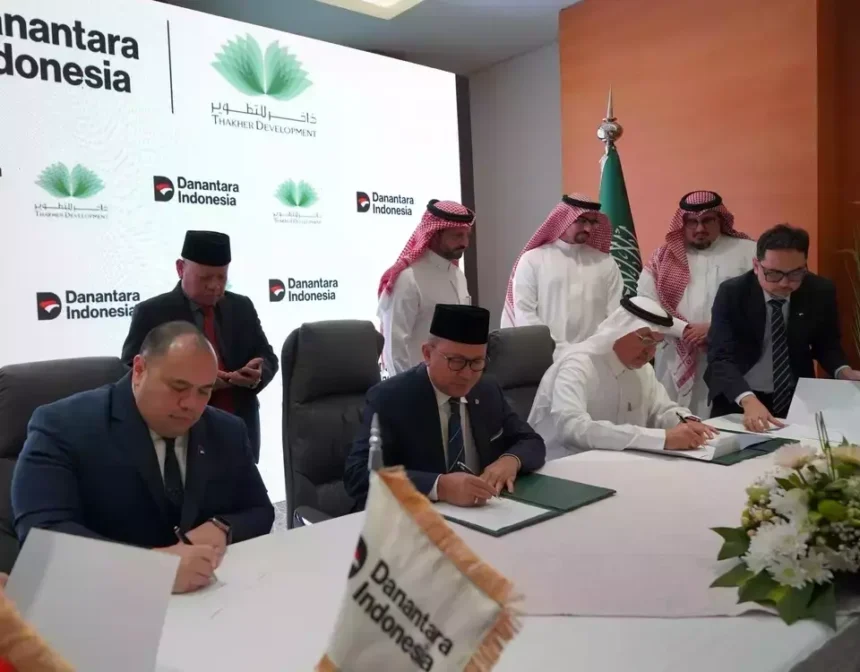
The deal was officially formalized through a signing ceremony between Danantara Investment Management, the fund’s specialized investment arm, and Thakher Development Company.
Danantara successfully secured these assets after winning a competitive bidding process based on its real estate development concept.
It triumphed over a field of more than 90 other international bidders, underscoring the fund’s strategic vision.
This acquisition officially marks Danantara’s significant entry into Makkah’s prestigious hospitality sector.
It represents a crucial initial phase of a meticulous, long-term strategy designed to enhance services for Indonesian Hajj and Umrah pilgrims.
In a statement, Danantara Indonesia Chief Executive Rosan Roeslani confirmed the transaction’s strategic value.
He called the signing “an important first step in securing strategic assets that can support Indonesia’s efforts to improve services for pilgrims.”
He emphasized a commitment to phased development guided by rigorous feasibility studies and prudent governance.
Acquired Assets And Future Development Master Plan
Under the terms of the landmark transaction, Danantara has acquired the Novotel Makkah Thakher City.
This is a large, fully operational hotel featuring 1,461 rooms, providing immediate operational capacity and cash flow.
Crucially, the deal also includes the acquisition of 14 strategically located land plots.
These total an expansive area of approximately 4.4 hectares, specifically earmarked for substantial future development.
These land plots form the foundation of Danantara’s long-term master plan.
It envisions a phased development encompassing a mix of hospitality, essential retail, and pilgrim support facilities.
All these are designed to seamlessly integrate with Makkah’s broader urban development framework and regulatory standards.
The broader project, subject to comprehensive technical studies and necessary regulatory approvals from Saudi authorities.
It could eventually support a significant scale-up of up to around 5,000 hotel rooms, demonstrating the immense potential for specialized pilgrim accommodation.
Initial assessments strongly suggest that the acquired assets possess compelling potential to support both the accommodation and essential services required for Indonesian pilgrims.
This is subject to final technical and regulatory clearance, which is a non-negotiable step in the project’s timeline.
To ensure seamless execution and strict alignment with local Saudi regulations and established market practices.
Danantara has entered into a crucial partnership with Al Khomasiah Real Estate Development, a local developer with extensive experience in Makkah’s unique development environment.
Furthermore, the Indonesian sovereign wealth fund is actively coordinating with the Saudi government through the Royal Commission for Makkah City and Holy Sites.
This ensures full integration and cooperation as part of the ongoing planning process for the first phase of this long-term, bilateral endeavor.
Rosan Roeslani noted that “This agreement lays the foundation for a long-term development strategy and provides a structured framework for future stages.”
He explicitly referenced key phases including development, construction, hotel operations, and the provision of essential support services, ensuring a governance-first approach.
Commitment To Regulatory Adherence And Pilgrim Services
The phased execution strategy for this ambitious project places a clear and unwavering emphasis on regulatory adherence, prudent governance, and long-term sustainability.
This reflects the responsible mandate of the Danantara fund.
All subsequent development phases—from construction planning and initial development to the eventual hotel operations and provision of related support services.
They will be carried out in meticulous coordination with all relevant authorities in both Saudi Arabia and Indonesia, strictly adhering to all applicable licensing, environmental, and governance requirements in both jurisdictions.
The explicit goal is to transition away from the current fragmented approach to pilgrim services.
It aims towards an integrated, state-backed solution that guarantees Indonesian pilgrims access to high-quality, strategically located accommodation and tailored support throughout their spiritual journeys.
By securing these prime assets in Thakher City, Danantara is establishing a physical and operational base.
This can significantly mitigate logistical complexities and reduce the high costs often associated with fragmented private sector arrangements.
The fund’s strategic investment in the Makkah hospitality sector represents an innovative use of sovereign wealth.
It seeks to achieve a vital national, social, and religious objective, moving beyond purely financial returns to incorporate social welfare benefits for millions of Indonesian citizens.
The strategic importance of this asset base, designed to support the needs of the largest Muslim population globally.
This ensures that the long-term cooperation framework established with the Saudi government, particularly the Royal Commission for Makkah City and Holy Sites, will be foundational to the project’s success, confirming its status as a matter of long-term national interest for Indonesia.
Financial And Regional Market Impact Of Captive Assets
From a financial analysis standpoint, this acquisition represents an innovative deployment of Sovereign Wealth Fund (SWF) capital.
It strategically blends financial return with critical Social Return on Investment (SROI), a mandate rarely seen among ASEAN-based SWFs.
While the initial asset provides immediate cash flow, the true economic impact lies in Danantara’s ability to create a massive, non-cyclical, captive demand anchor within Makkah’s hyper-competitive hospitality market.
By dedicating up to 5,000 rooms to Indonesia’s annual 2.2 million+ pilgrims, the fund effectively removes a significant block of predictable demand from the open market.
This stabilizes occupancy rates and reduces overall volatility for its acquired assets, insulating them from typical Makkah hospitality sector fluctuations.
For the local Makkah market, this deal validates Saudi Vision 2030’s strategy to attract mission-driven foreign direct investment (FDI) into its pilgrim infrastructure.
It showcases a successful shift from pure domestic development financing to internationally capitalized, segmented real estate solutions.
This will potentially increase future land and asset values for similar projects targeting other large Muslim-majority countries.
Regionally, the move provides Indonesia with significant leverage over the Hajj/Umrah logistics supply chain.
This is a perennial source of public dissatisfaction and expense, allowing for centralized quality control and potentially lowering the overall cost structure for Indonesian citizens.
Critically, this sets a powerful precedent, likely prompting other large Islamic nations, such as Pakistan and Bangladesh, to consider similar SWF-backed strategies.
Thus, accelerating the financialization and sovereign-backed segmentation of prime Holy City real estate, which will intensify regional competition for Makkah assets.