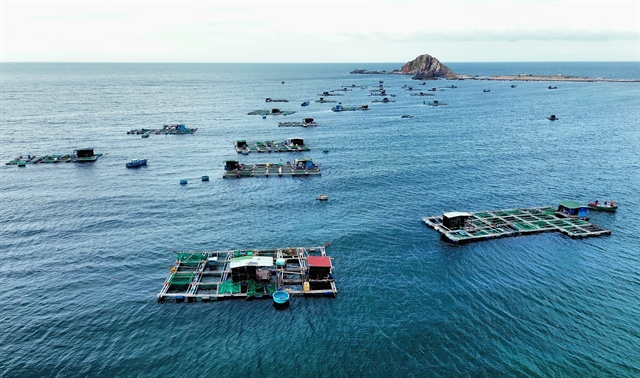
Việt Nam’s Strategic Shift to Offshore Aquaculture Drives Blue Economy Goals
Việt Nam’s fisheries sector is currently undergoing a significant and necessary transition, moving away from conventional coastal catching practices toward high-tech offshore aquaculture, with key coastal provinces like Khánh Hòa and Quảng Ninh leading the development of industrial-scale models. This strategic national initiative is considered an essential component in the country’s broader vision to build a sustainable blue economy, necessitating stronger policy frameworks, advanced technology adoption, and coordinated Investment to fully unlock the vast potential inherent in marine farming.
Khánh Hoà, a province with deep historical roots in fisheries, is emerging as a prime pioneer in this modernization drive. It has successfully shifted from traditional wooden cages, which were typically situated close to shore and vulnerable to natural elements, to robust offshore HDPE (High-Density Polyethylene) cage systems.
These modern cages are engineered to withstand powerful waves and adapt effectively to the increasingly severe impacts of climate change, offering a more secure and sustainable farming environment. A key milestone in this modernization was the establishment of the Vạn Ninh High-Tech Marine Farming Cooperative, which marked the province’s first industrial-scale marine aquaculture cooperative.
Pilot farming models for high-value species such as cobia, pearl grouper, and lobster in the areas of Cam Ranh and Đại Lãnh have already demonstrated exceptional Economic performance, reporting profit margins that are significantly higher—between 110–170 per cent—compared to the older, traditional wooden-cage systems. These new technologies are not only crucial for providing a cleaner and safer farming environment but also for reducing ecological pressure on nearshore waters, thereby mitigating pollution and potential conflicts with coastal ecosystems.
Technological Adoption and Value Chain Integration Address Market Bottlenecks
Despite Việt Nam’s significant natural advantages for developing marine aquaculture, the sector’s growth remains substantially below its potential, a situation exacerbated by recent slowdowns in implementation due to shifts in management mechanisms. The national pivot from capture fisheries toward aquaculture and resource conservation aligns with global green and circular Economic trends, positioning marine farming to become a high-value sector; however, the country still predominantly exports raw products, failing to fully leverage its biological resources compared to international counterparts in Europe, the US, and other regional countries.
Data from the Ministry of Agriculture and Environment (MAE) highlights the fragmented nature of current production: there are over 6,500 nearshore marine farming establishments and more than 910 mid-shore sites, yet a mere 27 offshore farms, leaving production vulnerable to pollution and natural disasters. The devastating losses suffered in Vân Đồn, Quảng Ninh Province, following Typhoon Yagi in 2024, which destroyed entire cage systems, served as a stark reminder of these vulnerabilities.
Limited technology, weak infrastructure, and loose value-chain linkages contribute to unstable output, making long-term contractual agreements challenging. Furthermore, uncoordinated and rapid restocking after storms frequently disrupts the supply–demand balance, leading to sharp price drops, hurting the Finance of local farmers.
To counter these fundamental bottlenecks, numerous coastal provinces are actively promoting the development of closed marine aquaculture value chains. In Quảng Ninh, efforts include establishing a seafood market model in Hà Nội featuring recirculating water systems, HACCP-standard processing zones, and cooperative-specific packaging to ensure a fresh, traceable supply to urban consumers.
The proposed digital transformation tools, including GPS-based farm mapping, cloud-based data storage, AI-supported disease diagnosis, and a dedicated e-commerce platform, are designed to enhance professionalism and stabilize market supply within the aquaculture sector.
Policy Support, Infrastructure Investment, and Future Regulatory Frameworks
The future success of Việt Nam’s industrial aquaculture sector hinges on robust government support, targeted infrastructure Investment, and the finalization of clear regulatory frameworks. Khánh Hoà Province is at the forefront of policy implementation, having secured government approval for a pilot program that defines high-tech marine aquaculture zones extending from the shoreline out to six nautical miles.
The province has successfully issued 39 industrial aquaculture permits and is guiding enterprises through the complex procedures for marine area allocation. Experts from the Directorate of Fisheries stress that achieving sustainable marine aquaculture requires comprehensive cooperation among the State, private Businesses, and industry associations, with strong value-chain links essential for forming the large enterprises capable of driving industrial-scale production.
Current regulations facilitating the transition away from certain unsustainable fishing activities have created new opportunities for coastal provinces to integrate aquaculture with tourism and marine services, effectively raising community incomes. Recommendations from the Khánh Hoà Department of Agriculture and Environment include governmental Investment support for critical farming infrastructure, such as marker buoys, advanced cage-anchoring systems, and specialized fishery logistics centers.
Furthermore, they propose policies that explicitly link marine aquaculture with sectors like tourism and oil–gas to diversify revenue streams. The MAE is actively developing national standards for marine aquaculture, expected to be completed in 2026, which will form a crucial basis for future Investment, insurance, and risk management practices within the sector.
A critical immediate task identified by the Việt Nam Marine Farming Association is the finalization of long-term marine-area allocation procedures. They advocate for establishing industrial clusters and dedicated marine aquaculture zones—both offshore and onshore—where enterprises can invest in shared infrastructure while fishers and cooperatives lease space for production.
This collaborative model is designed to reduce initial capital costs, enhance professionalism, mitigate environmental pollution, and ensure compliance with internationally recognized traceability standards, thereby strengthening the country’s blue Investment potential.
Financial Analyst Commentary: The ASEAN Competitive Dynamics in High-Value Seafood
Việt Nam’s commitment to industrial-scale offshore aquaculture represents a strategic, long-term Investment to secure its competitive position within the dynamic ASEAN seafood export market, which is currently dominated by nations excelling in specific niche areas, such as shrimp from Thailand and Indonesia. The transition to resilient HDPE cages and high-value species like cobia and grouper shifts Việt Nam’s focus from high-volume, low-margin products (like pangasius) toward high-margin, premium-tier seafood demanded by markets in Japan, the EU, and the US.
The current fragmentation (only 27 offshore farms) implies that the initial capitalization requirement for this high-tech shift will be massive, demanding specialized Finance instruments, potentially including state-backed guarantees or green Investment bonds, given the environmental and climate resilience aspects of the new infrastructure. This industrialization, if successful, will create a comparative advantage over regional competitors who rely heavily on traditional, nearshore aquaculture that is increasingly vulnerable to environmental degradation and typhoons, as tragically demonstrated in Quảng Ninh.
The successful integration of aquaculture with tourism, as seen in Khánh Hoà, is a vital value-chain innovation, moving the Business beyond simple commodity export to a vertically integrated experiential Economic model. This integration not only diversifies revenue but also enhances the perceived quality and traceability of the product, commanding higher export prices and ultimately strengthening Việt Nam’s “blue” sovereign brand in global seafood Finance and trade.