Software Glitches Halt LRT3’s Scheduled Commencement
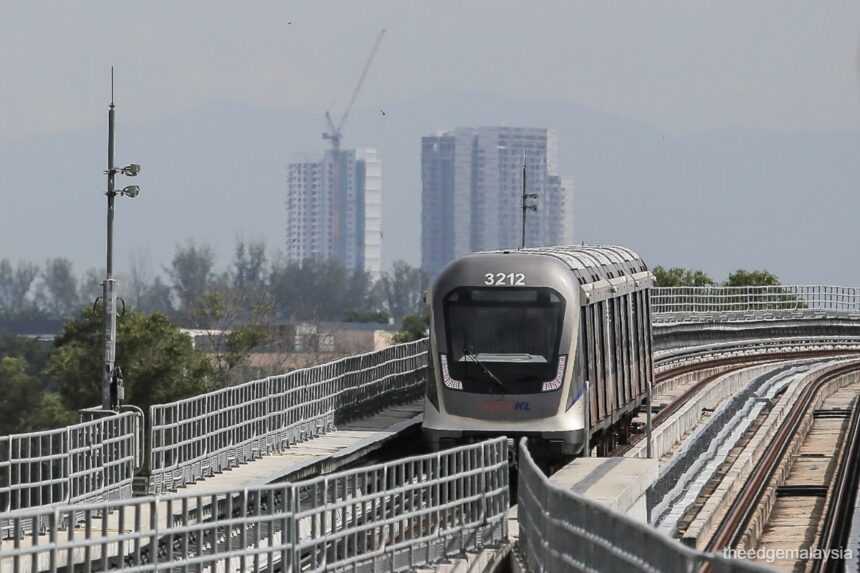
The highly anticipated commencement of operations for the LRT3 Shah Alam Line, a crucial public transport project for the Klang Valley, has been officially postponed beyond its revised December 31 deadline this year, confirming earlier market reports. Officials from Prasarana Malaysia Bhd, the LRT3 asset owner, informed reporters during a recent briefing that the decision was necessary following the discovery of multiple software glitches during the critical fault-free run (FFR) testing phase.
No new operational date has been provided at this time, leaving commuters waiting for the next official announcement. The 37.8 km rail alignment, also known as the Shah Alam Line, was initially scheduled to begin service on September 30 of this year before being pushed back to the year-end deadline.
Setia Utama LRT 3 Sdn Bhd (SULRT3) project director, Patrick Hwang Chee Leong, detailed the technical setbacks, revealing that a total of 33 software glitches surfaced during the FFR tests, which originally commenced on August 26, 2025. These crucial FFR tests required the first train to successfully complete 4,000 km and the subsequent trains to run 2,500 km each without any faults, a rigorous standard set by the transport regulator to ensure passenger safety and system reliability.
Despite 11 initial attempts, the required distance was not achieved due to the technical problems uncovered. Mr. Hwang assured that SULRT3, as the main contractor, would not face penalties for the delay, as resolving issues found during testing is an integral part of their existing contract and the overall system validation process.
This critical testing phase is essential for delivering a stable and reliable public transit system to the densely populated Shah Alam corridor.
Technical Faults And The Fixed-Price Contract Assurance
The nature of the technical faults uncovered during the two-and-a-half-month testing period for the LRT3 system was predominantly software-related, encompassing a range of critical operational issues. Specifically, engineers noted problems with the trains docking properly at stations, malfunctions with the automatic door systems, instances where trains were unable to successfully leave a station after completion of passenger loading, and frequent false alarms related to speed monitoring and stopping accuracy.
While these 33 glitches have temporarily halted the launch of the LRT3 project, Prasarana president and chief executive officer Amir Hamdan emphasized that the delay would not impose any additional costs on the government due to the project’s fixed-price contract structure. This financial structure places the burden of resolving such unexpected technical complications on the main contractor, ensuring fiscal predictability for the government.
Despite the setbacks, Mr. Amir confirmed that progress is being made; the first train has successfully completed the required 4,000 km fault-free run distance, and three other trains have each reached approximately 3,000 km, moving closer to the regulator’s specified standard of 2,500 km. This progress suggests that the software issues are being systematically addressed and resolved by the technical teams.
Prasarana’s current internal schedule anticipates completing the full testing of all operational trains by the end of January, after which a definitive update on the new public launch date for the LRT3 Shah Alam Line will be provided to the public and the media next month.
Alignment With Ministry Timeline And Regional Investment Context
Prasarana’s CEO, Amir Hamdan, was careful to reassure the public and stakeholders that, despite the missed operational deadline, the overall LRT3 project schedule still remains aligned with the Transport Ministry’s long-term timeline, as the Ministry receives comprehensive weekly progress updates on the rigorous testing and defect resolution process. He reiterated that the unforeseen software glitches—an inherent risk in complex automated transit systems—were the sole reason for missing the initial operational deadlines.
The need for a fault-free run, requiring trains to operate for thousands of kilometers without incident, is a non-negotiable regulatory prerequisite that prioritizes public safety above all else, making these delays unavoidable but necessary. This delay, however, must be viewed within the broader context of regional public transport infrastructure investment.
While Malaysia’s urban rail projects, including the LRT3, face complex technical and logistical hurdles, they represent crucial long-term investments designed to enhance urban mobility, reduce reliance on private vehicles, and support sustainable economic development in the Klang Valley, a key commercial hub for ASEAN. Successful completion of projects like the LRT3 bolsters investor confidence in Malaysia’s capability to deliver major infrastructure, contrasting with the political risks and funding uncertainties seen in other regional transit initiatives.
The fixed-price contract approach utilized for the LRT3 is a risk-mitigation strategy that could serve as a financial model for future large-scale projects, protecting government budgets from unexpected cost overruns inherent in complex technology deployment. The final operational date announcement will be a key indicator of the project’s maturity and readiness to integrate into the existing high-capacity rail network.
Financial And Real Estate Implications Of The LRT3 Postponement
The short-term postponement of the LRT3 launch, while technically managed under a fixed-price contract that shields government finances from direct cost overruns, carries significant, yet often indirect, financial and economic implications for the Klang Valley. From a Real Estate perspective, properties along the LRT3 alignment—specifically those in the key transit-oriented development (TOD) corridors of Bandar Utama, Shah Alam, and Johan Setia—may face a temporary sentiment dip.
Commuters and commercial investors who factored the December operational date into their leasing or purchasing decisions will experience an unquantifiable opportunity cost related to continued traffic congestion and delayed access to the rail network, potentially impacting immediate rental yields and capital appreciation velocity in these areas. Furthermore, the delay impacts the projected ridership targets and, consequently, the revenue forecasts for Prasarana’s overall rail division.
While the LRT3 operates independently, delays in integrating new, high-capacity lines into the existing network disrupt the planned modal shift strategy, meaning the anticipated reduction in private vehicle use and associated societal cost savings (e.g., lower carbon emissions, reduced fuel consumption) are deferred. Crucially, the fixed-price contract structure, while financially protective, shifts the risk entirely to the main contractor and its supply chain.
For the contracting ecosystem, this implies extended working capital requirements, potentially straining the balance sheets of sub-contractors and technology providers responsible for resolving the 33 software glitches. The need for exhaustive, fault-free testing underscores the regulatory maturity of Malaysian infrastructure development, but the subsequent delay introduces a period of uncertainty that property developers and retail operators along the Shah Alam line must now manage, potentially delaying the full realization of their Investment returns until the new launch date is finalized and rigorously adhered to.