Strategic Expansion Of POSCO In Northern Vietnam
The global push for electrification has reached a significant milestone with the news that POSCO Future M will establish its first large-scale battery materials facility in Thai Nguyen province. This ambitious 400 million dollar investment reflects the increasing importance of the Vietnamese industrial landscape as a critical node in the global transition toward clean energy and sustainable transportation.
By selecting the Song Cong II Industrial Park for this 37 hectare project, the company is positioning itself to capitalize on the region rapidly maturing manufacturing ecosystem and its strategic proximity to major export markets. This facility is particularly notable as it marks the first overseas cathode materials production site for the subsidiary, indicating a high level of confidence in the local infrastructure.
Construction is scheduled to commence in the second half of 2026, with the goal of reaching full operational status by 2028. Once the plant is fully functional, it will boast an impressive annual capacity of 55,000 tonnes, serving as a primary supply hub for leading electric vehicle manufacturers in the United States, the European Union, and the Republic of Korea. The decision by POSCO to anchor its battery materials strategy in northern Vietnam highlights a broader trend of high-tech diversification.
Industrial Synergy And Logistics Advantages In Thai Nguyen
The selection of Song Cong II Industrial Park was the result of exhaustive feasibility studies that evaluated several regional competitors, including Indonesia and other ASEAN neighbors. Representatives from POSCO Future M specifically noted that Vietnam offers superior advantages in terms of production and logistics costs, which are essential for maintaining margins in the competitive battery components market.
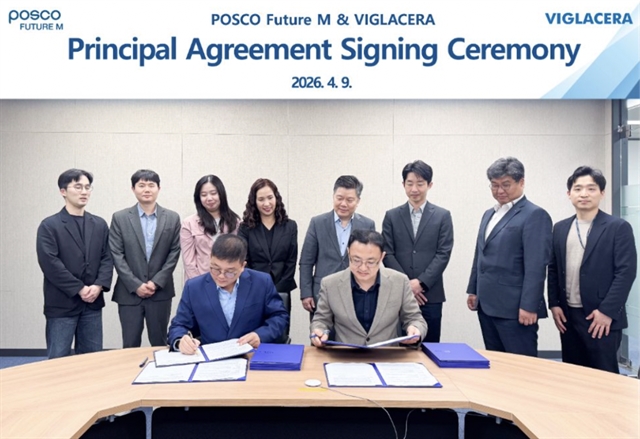
The industrial park, developed by Viglacera Corporation, provides the necessary modern infrastructure, including a stable and ample power supply which is a non-negotiable requirement for precision chemical processing. Furthermore, the geological stability of the Thái Nguyên site was cited as a key factor in ensuring the long-term safety and efficiency of the specialized manufacturing equipment.
The strategic location of the park, adjacent to the Hanoi-Thai Nguyen Expressway and Ring Road 5, ensures seamless connectivity to the capital and major maritime ports. This geographic benefit allows POSCO to efficiently integrate into existing supply chains that already serve global giants like Samsung. By choosing an established industrial zone, the South Korean firm minimizes the risks associated with greenfield developments while gaining immediate access to a skilled labor force.
Macro-Financial Analysis Of High-Tech Foreign Investment
The entry of POSCO into the Vietnamese battery materials market signifies a structural shift in the quality of foreign direct investment entering the country. We analyze that this 400 million dollar capital injection is not merely an expansion of manufacturing capacity but a strategic move to secure a dominant position in the upstream segment of the electric vehicle value chain.
By focusing on cathode and anode materials, the company is targeting the most value-intensive components of the modern battery, which currently account for a significant portion of total vehicle production costs. We observe that Viglacera experience in managing over 18 industrial parks nationwide has been a key enabler for attracting such high-quality investment, bringing the total capital attracted by the firm to over 20 billion dollars.
This trend suggests that Vietnam is successfully transitioning from a low-cost assembly hub into a sophisticated destination for advanced technology and chemical engineering. The presence of other global leaders like Foxconn and Amkor in the same ecosystem provides a de-risking effect for POSCO, as it ensures the availability of specialized support services and shared logistical infrastructure. We anticipate that this project will act as a catalyst for further investments in the green economy.
Strategic Regional Competitiveness And Supply Chain Security Analysis
The decision by POSCO to prioritize Thailand over regional peers like Indonesia for its primary cathode production hub represents a significant analytical pivot in Southeast Asia industrial competition. We analyze that while Indonesia possesses superior nickel reserves, Vietnam logistical efficiency and integration into the Northern High Tech Corridor offer a more attractive risk adjusted return for specialized chemical manufacturing. This facility effectively anchors Vietnam as a critical midstream player in the global EV battery supply chain, moving beyond simple assembly into high value precursor production.
This strategic move by the South Korean conglomerate serves to diversify the supply chain geography for US and EU markets, mitigating geopolitical risks associated with over concentration in a single jurisdiction. We observe that the 55,000 tonne annual capacity will provide Vietnam with a unique leverage point in trade negotiations, as cathode materials are the primary cost driver in battery pack economics. The presence of this facility in Thai Nguyen will likely stimulate a secondary market for specialized chemical suppliers and industrial gas providers, further deepening the local industrial base.
From a regional market perspective, the success of the Song Cong II project will likely prompt a competitive response from neighboring ASEAN economies seeking to upgrade their own manufacturing capabilities. However, the existing infrastructure synergy with established electronics giants provides northern Vietnam with a distinct first mover advantage in the 2026 2030 industrial cycle. Ultimately, this investment reinforces the archipelago status as a premier destination for high precision green tech, ensuring long term fiscal stability through the export of sophisticated industrial components rather than raw materials.