Straits Times Index Performance And Banking Sector Resilience
The financial landscape showed notable strength as Singapore stocks closed on a positive note this Friday, marking a successful end to the trading week on April 10, 2026. The benchmark Straits Times Index demonstrated a steady upward trajectory by rising 0.3% to settle at 4,989.41 points, which represents a respectable gain of 0.7% compared to the closing figures recorded during the previous week.
This bullish sentiment was largely underpinned by the robust performance of the three major local banking institutions, which remain the heavyweights of the domestic equity market. DBS led the charge with a 0.3% increase to reach 57.35 dollars, while OCBC showed even greater momentum with a 1.3% climb to end the day at 22.47 dollars. UOB also contributed to the positive closing by edging up 0.2% to 37.39 dollars, highlighting a collective resilience within the financial services sector.
Investors continue to look toward these high-quality Singapore stocks as a primary defensive play against inflationary pressures and regional market volatility. The broader market breadth remained healthy throughout the session, with gaining securities significantly outnumbering losers by a count of 380 to 201. A total of 4.4 billion securities worth 1.9 billion dollars changed hands, reflecting a high level of liquidity and engagement from both institutional and retail participants.
Blue Chip Highlights And Broader Market Dynamics
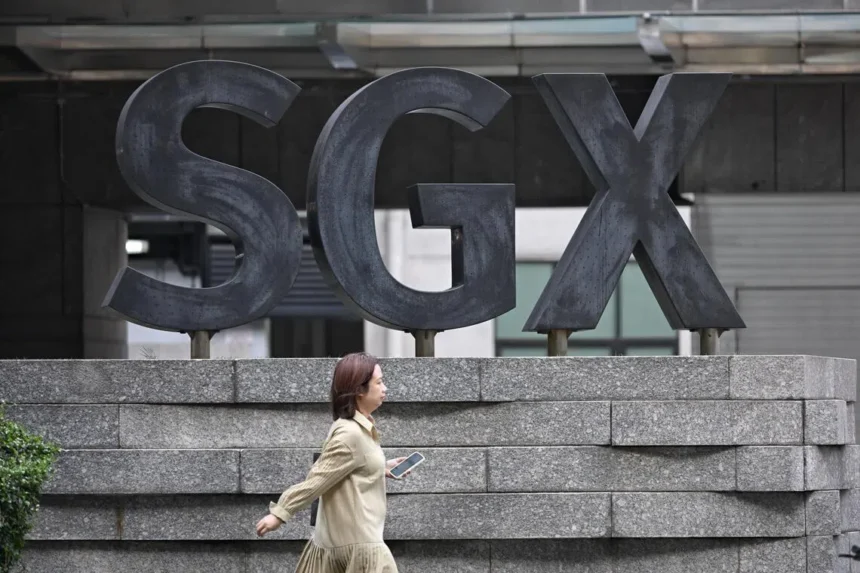
The Singapore Exchange itself emerged as the standout performer among the blue-chip constituents, witnessing a substantial surge of 3.8% to close at 21.09 dollars. This impressive rally suggests a growing optimism regarding the exchange’s role as a regional financial hub and its ability to attract high-value listings and trading volume in the current environment. However, the session was not without its laggards, as DFI Retail Group faced significant downward pressure, dropping 4.9% to end at 4.29 US dollars.
This divergence in performance highlights the importance of sector-specific analysis when evaluating Singapore stocks, as retail and hospitality segments face different headwinds compared to financial and industrial sectors. The overall mood on the trading floor was further bolstered by a synchronous rally across the Asian region, with Hong Kong’s Hang Seng Index and Japan’s Nikkei 225 both recording meaningful gains. South Korea’s Kospi also advanced by 1.4%, while Malaysia’s FTSE Bursa Malaysia KLCI added 0.3% to the collective recovery.
This widespread upward movement across major Asian hubs indicates that the demand for Singapore stocks is part of a broader shift toward emerging and developed markets in the East. Experts suggest that the current market mechanics are driven by a combination of technical positioning and a cautious return of risk appetite following recent geopolitical stabilization efforts. As the week closes, the high trading volume serves as a testament to the vibrancy of the local bourse and its capacity to process large-scale capital flows efficiently.
Macro-Financial Analysis Of Regional Market Sentiments
The recent performance of Singapore stocks reflects a fragile but constructive tone that has permeated the global financial markets after a period of intense volatility. Analysts observe that the current rally across Asian equities marks the first weekly gain since the escalation of regional conflicts in late February, signaling a potential stabilization in investor sentiment.
However, the current optimism is viewed by many as temporary, described by some as a market renting conviction into the weekend rather than celebrating a permanent resolution of global tensions. This nuanced view is essential for institutional desks that are managing multi-asset portfolios across the ASEAN bloc, as the underlying economic bill will likely be settled once markets reopen next week. The technical strength of the Straits Times Index near the 5,000-point psychological barrier suggests that Singapore stocks are entering a critical phase of price discovery.
We analyze that the continued dominance of the local banks provides a stable floor for the index, while the outperformance of the Singapore Exchange reflects a structural premium being placed on transparency and regulatory stability. As global capital continues to seek out safe havens with high yield potential, the Indonesian and Malaysian counterparts are also seeing a spillover effect, though the depth of the Singapore market remains unparalleled in the region. Moving forward, the interaction between US dollar strength and regional interest rate parity will be the primary engine driving the next wave of capital allocation.
Regional Equity Integration And Strategic Capital Flows Analysis
The synchronized advance of Singapore stocks alongside regional peers in April 2026 underscores a strategic shift toward quality and defensive yield in the Southeast Asian capital markets. We analyze that the 0.7% weekly gain in the Straits Times Index is a mechanical result of institutional rebalancing away from hyper-volatile global growth tech toward the cash-flow-rich banking and exchange sectors of Singapore. The 1.3% climb in OCBC and the 3.8% surge in the Singapore Exchange itself indicate that smart money is prioritizing the intermediaries of financial flow over speculative assets. This suggests that the market views the current regional recovery as trade-led rather than consumption-led, placing a premium on the infrastructure of finance.
Furthermore, we observe that the divergence between the performing blue chips and the struggling DFI Retail Group highlights a bifurcated economic recovery within the ASEAN region. While the high-finance sector benefits from elevated interest rate environments and increased market volatility, the retail segment continues to grapple with the thinning of consumer margins caused by sticky inflation. This sectoral decoupling is a critical signal for investors; the regional equity market is currently rewarding institutions that provide the pipes and plumbing of the economy while penalizing those reliant on mass-market discretionary spending. The fact that gainers led losers 380 to 201 demonstrates a broad-based desire for equity exposure, but the concentration in banking shares reveals a defensive underlying posture.
Looking ahead, we anticipate that the 5,000-point resistance level for the Straits Times Index will act as a litmus test for the durability of the current market optimism. If Singapore stocks can consolidate above this level, it will likely trigger a secondary wave of passive capital inflows from global emerging market funds seeking refuge from external shocks. The 1.9 billion dollars in daily trade value serves as a strong liquidity foundation, indicating that the market has sufficient depth to absorb potential profit-taking in the coming week. Ultimately, Singapore’s role as the regional anchor remains unchallenged, as its ability to synthesize global optimism with localized stability continues to attract a structural premium over its neighboring counterparts.