Bilateral Economic Expansion Through The WGTB Protocol
The diplomatic landscape between Southeast Asia and Eurasia has reached a new milestone as Indonesia and Russia recently solidified their economic ambitions. By officially signing the protocol from the 7th Indonesia-Russia Working Group on Trade, Investment, and Industry, the WGTB framework now serves as a primary driver for enhanced bilateral connectivity.
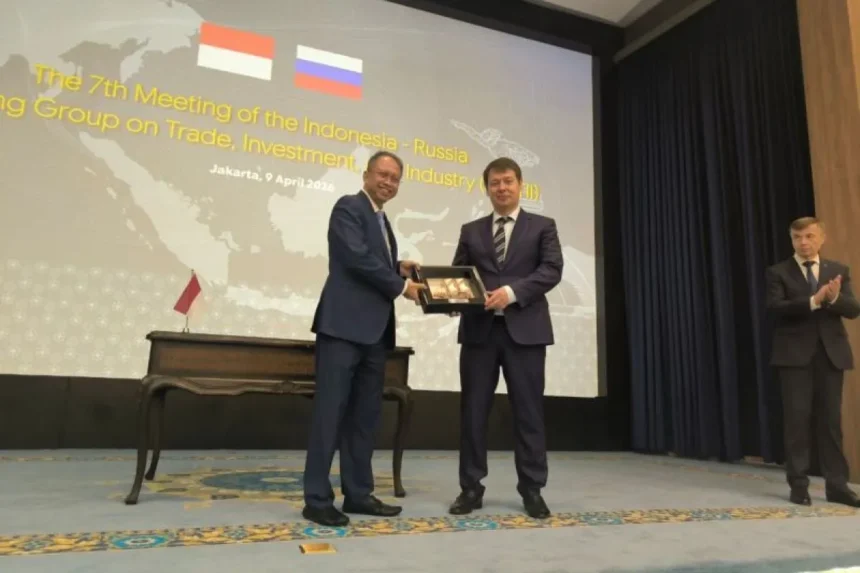
This significant agreement was formalized by Edi Prio Pambudi, the Deputy for International Economic Cooperation, and Vladimir Illichev, the Russian Deputy Minister of Economic Development, during a high-level summit held in Jakarta. The primary objective of the protocol is to reaffirm a mutual commitment to strengthening economic ties that benefit both nations through expanded market access and the development of value-added industrial sectors.
As global trade dynamics continue to shift, the implementation of the WGTB initiatives is expected to create more robust channels for capital flow and technological exchange. The signed document acts as a comprehensive roadmap that outlines specific progress made in priority sectors while establishing clear follow-up plans for future technical agreements. Officials have noted that this collaborative effort is essential for ensuring the continuity of bilateral cooperation in an increasingly complex global market.
Strategic Sector Integration And Infrastructure Development
The cooperation outlined in the new agreement covers a broad spectrum of critical sectors that are fundamental to the national development goals of both countries. Key areas of focus include energy, agriculture, industry, and large-scale infrastructure projects that require significant technical expertise and long-term investment commitment. Through the WGTB mechanism, both nations are also prioritizing advancements in logistics and the management of special economic zones to streamline the movement of goods and services.
This strategic integration extends into newer frontiers such as the creative economy and climate-related initiatives, reflecting a modern approach to international diplomacy that goes beyond traditional commodity trade. The protocol ensures that technical agreements are not merely theoretical but are backed by actionable implementation guides. By fostering collaboration in the industrial sector, the agreement aims to boost the production of value-added goods, thereby moving away from a reliance on raw material exports.
The logistics component is equally vital, as improved supply chain connectivity will reduce the costs of doing business and enhance the competitiveness of Indonesian products. Furthermore, the commitment to climate-related initiatives demonstrates a shared understanding of the need for sustainable development. As these projects accelerate, the WGTB framework will likely become a benchmark for how emerging economies can successfully partner with major global powers to achieve shared prosperity through structured and transparent cooperation.
Macro-Financial Analysis Of The Indonesia Russia Economic Corridor
The formalization of this protocol signals a strategic diversification of Indonesia foreign economic policy, moving toward a more balanced engagement with major global powers. We analyze that the WGTB framework provides a necessary institutional buffer that de-risks bilateral projects by establishing a clear legal and technical foundation for long-term capital allocation.
For institutional investors, the focus on special economic zones and value-added industries suggests a shift toward higher-margin investments that can provide more stable returns compared to volatile commodity markets. The inclusion of logistics and infrastructure as priority sectors is particularly noteworthy, as these are the primary enablers of trade-led growth in the ASEAN region. We observe that as Indonesia continues to position itself as a central hub for regional trade, partnerships that enhance its industrial capacity are of paramount importance.
The WGTB agreement effectively addresses these needs by facilitating the transfer of technical knowledge and fostering a climate of trust between the two ministries. Furthermore, the acceleration of these projects is expected to have a positive impact on the national trade balance, provided that market access for Indonesian products is successfully realized. The move toward a more integrated economic relationship also reflects a broader trend within the G20 where emerging economies are seeking to secure their supply chains through bilateral protocols.
Geopolitical Diversification And Regional Trade Resilience Analysis
The recent signing of the WGTB protocol represents a sophisticated pivot in Southeast Asia regional trade architecture, moving toward a multi-polar economic strategy that mitigates over-reliance on traditional Western financial orbits. We analyze that the deepening of Indonesia-Russia industrial ties serves as a critical hedge for the Jakarta administration, particularly as it seeks to secure the capital-intensive energy and infrastructure projects necessary for the Nusantara transition. This bilateral mechanism provides a strategic alternative for technology transfer in heavy industry and specialized logistics, sectors where Russian technical parity offers a competitive entry point for the archipelago burgeoning special economic zones.
From an ASEAN market perspective, this engagement is a mechanical necessity for maintaining regional neutrality while aggressively expanding the national export footprint. We observe that the emphasis on value-added industries within the protocol is a direct response to the domestic down-streaming mandate, ensuring that future trade volumes are defined by high-tier manufacturing rather than raw mineral extraction. The 7th WGTII outcomes suggest that the regional market is moving toward a more fragmented but resilient supply chain model, where bilateral protocols act as the primary conduits for cross-border investment stability. This structural shift de-risks the local industrial sector against global trade wars by anchoring production cycles in long-term inter-governmental agreements that bypass immediate retail market volatility.
Furthermore, the inclusion of climate-related initiatives and the creative economy indicates that the Indonesia-Russia corridor is evolving into a partnership. We anticipate that the acceleration of these projects will bolster the national sovereign credit profile by demonstrating a diversified and active foreign direct investment pipeline. For financial analysts, the primary metric of success will be the conversion rate of these protocols into operational logistics hubs and joint industrial ventures within the next two fiscal years. Ultimately, this constructive trajectory cements Indonesia role as a non-aligned economic powerhouse, capable of synthesizing global expertise to fortify its internal market resilience and regional leadership position in the 2026 trade landscape.