Navigating Global Trade And The New Reciprocal Tariff Framework
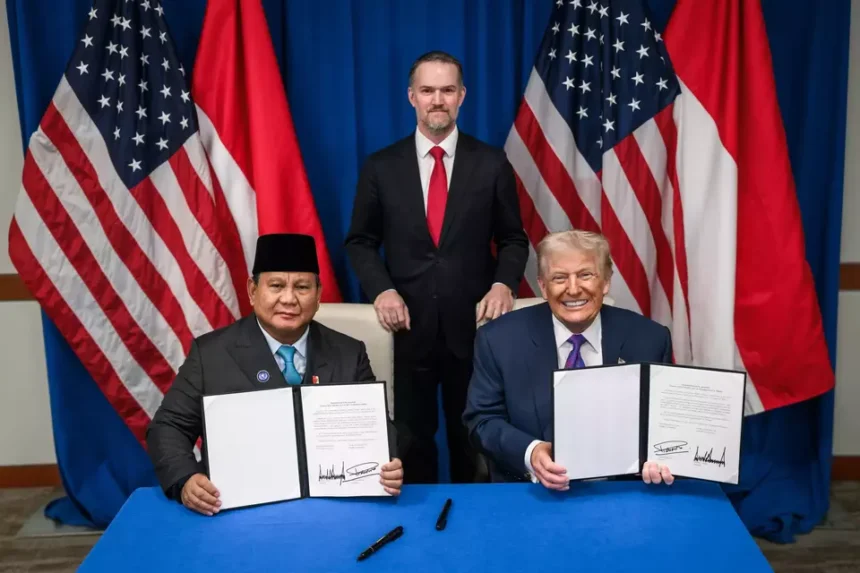
The recent signing of the landmark reciprocal trade agreement between Indonesia and the United States marks a significant pivot toward economic diplomacy, specifically centered on a reduced tariff structure that prioritizes commercial growth over geopolitical entanglements. Chief Economic Minister Airlangga Hartarto confirmed that the Trump administration was willing to keep the arrangement strictly limited to trade issues, successfully removing controversial clauses related to defense and security.
This strategic victory came shortly after the formal signing with US Trade Representative Jamieson Greer in Washington, following a high-level meeting between President Prabowo Subianto and President Donald Trump. The removal of non-economic provisions, such as those concerning nuclear reactor development and South China Sea policies, ensures that the Indonesian government can maintain its non-aligned foreign policy while reaping the benefits of increased market access.
By securing 90% of its initial demands, Jakarta has successfully navigated a complex negotiation landscape that many regional neighbors found challenging. The core of the deal focuses on the implementation of a more favorable tariff regime, which is expected to revitalize the domestic manufacturing and agricultural sectors by lowering the cost of entry into the massive American consumer market. This focused approach distinguishes the Indonesian agreement from other regional pacts, as it avoids the stringent defense-related requirements that have historically complicated bilateral trade talks.
Market Access Enhancements And Sectoral Commodity Exemptions
A vital component of this agreement is the substantial reduction in the financial burden placed on Indonesian exporters, with the US maintaining a 19% tariff on most goods rather than the originally threatened 32%. This lower rate is further bolstered by full exemptions on 1,819 specific product categories, including critical commodities like palm oil, electronic components, and spices.
For the textile industry, a specialized rate quota system has been established, allowing a predetermined quantity of eligible exports to enter the US market at a 0% tariff, providing a significant competitive advantage over other global suppliers. In exchange for these concessions, Indonesia has moved to eliminate duties on 99% of American products, ranging from essential agricultural goods to high-value automotive imports.
This reciprocal opening of markets is designed to address longstanding trade balance concerns while fostering a more transparent and predictable commercial environment. The negotiations also briefly addressed the arms trade, with the US promising to streamline and enhance defense trade without imposing the restrictive surveillance drone purchase requirements that had been rumored in previous months. By focusing on these tangible economic levers, the agreement ensures that the national economy remains at the forefront of the regional growth cycle throughout 2026.
Strategic Macroeconomic Stability And Regional Competitive Positioning
The finalization of this trade roadmap provides Indonesia with a unique psychological and economic hedge against the broader trend of global protectionism. From a professional financial analyst’s perspective, the successful negotiation of a lower tariff on Indonesian goods serves as a critical driver for the re-rating of local consumer and industrial equities.
We observe that the 19% cap provides a level of certainty that is essential for long-term capital expenditure in the manufacturing sector, particularly for firms that have been eyeing the North American market. The ability to secure exemptions for nearly two thousand product lines suggests that the government has effectively leveraged its strategic position in Southeast Asia to extract high-value concessions.
This agreement effectively positions Indonesia as a primary bridge between Western capital and the ASEAN consumer base, potentially leading to a displacement of regional trade flows from neighboring countries that lack similar preferential access. The synergy between the removal of a traditional trade tariff and the expansion of market access ensures that the organization of the domestic market is better prepared to handle future fluctuations in global commodity prices, setting a new benchmark for bilateral cooperation in the Pacific.
Regional Displacement And Capital Flows
The strategic separation of trade from defense in this deal represents a sophisticated decoupling that allows Indonesia to optimize its domestic fiscal policy without compromising its regional neutrality. From a capital markets perspective, the 13% reduction in the benchmark tariff on Indonesian goods acts as a direct subsidy to the export sector, significantly enhancing the enterprise value of local logistics and palm oil conglomerates. We anticipate that this agreement will trigger a massive reallocation of regional supply chain capital, as multinational corporations seeking a stable gateway to the US market shift their manufacturing hubs from more geopolitically aligned neighbors toward the Jakarta-led corridor. This displacement is not merely a localized phenomenon but a structural shift that could redefine the ASEAN competitive landscape for the remainder of the decade.
By successfully resisting the inclusion of nuclear or surveillance drone mandates, Indonesia has established a new precedent for middle-power diplomacy in a bipolar world. This allows the central bank more room for maneuver in its monetary policy, as the projected increase in foreign exchange reserves from duty-exempt commodity exports will likely provide a robust cushion for the rupiah against dollar volatility. The implementation of the textile quota system further illustrates a granular understanding of sector-specific sensitivities, providing a lifeline to a domestic industry that has struggled against lower-cost regional competitors. We expect that the resulting influx of US agricultural and automotive imports will drive down local inflationary pressures, thereby supporting a more accommodative domestic interest rate environment through 2027.
Ultimately, the removal of non-economic clauses signifies a market-oriented realism that prioritizes liquidity and job creation over ideological alignment. This deal effectively de-risks the Indonesian investment thesis, offering a high-transparency environment that contrasts sharply with the opaque regulatory frameworks often found in neighboring economies. As the current account deficit begins to stabilize under this new tariff regime, we anticipate a marked increase in the weighting of Indonesian equities within global emerging market indices. This strategic alignment ensures that the national economy is not just a participant in the global trade system but a primary architect of a more resilient, bilateral-focused ASEAN trade block. The cascading effects of this agreement will likely be seen in the expansion of industrial estates and the accelerated digital transformation of the local supply chain, cementing Indonesias role as a critical node in the global economy.