Accelerating Vietnam’s Green Garment Industry: The Crucial Role of Finance
Vietnam’s garment industry must urgently pivot from high-volume, cost-driven manufacturing towards green and circular operating models to sustain its competitive edge in the global marketplace.
Accessible green finance serves as the crucial enabler for this massive and necessary transition, demanding immediate action across the sector.
Recognizing this urgent shift, the strategic forum titled “Financing Vietnam’s Leap in Garment Sustainability” was co-hosted by Chan Chao International and CCX Partners on October 17 during the Vietnam International Textile & Garment Exhibition (VTG 2025).
This key event successfully brought together a diverse group of stakeholders, including policymakers, financiers, manufacturers, academics, and innovators, all focused on exploring how capital and investment can be mobilized to accelerate this necessary sustainability leap.
Strategic Dialogue on Policy and Competitiveness at VTG 2025
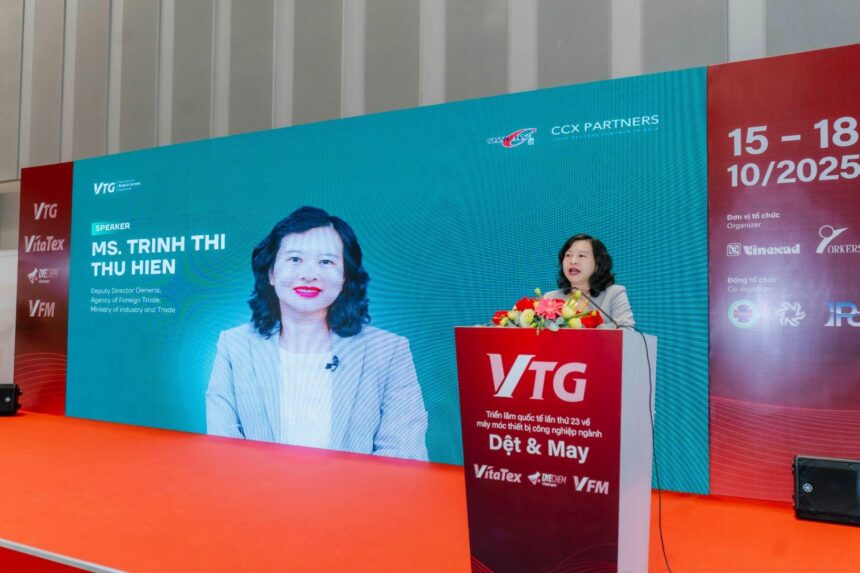
Opening the forum, Trinh Thi Thu Hien, the deputy director general of the Agency of Foreign Trade under the Ministry of Industry and Trade, provided critical strategic insights that framed the day’s discussions.
She outlined the driving forces behind this transformation, specifically citing Free Trade Agreements (FTAs) and the imperative to elevate Vietnam’s garment export competitiveness.
This elevation is achieved through meticulous rules of origin compliance and maximizing the effective utilization of tariff preferences offered by these agreements.
Hien stressed that while Vietnamese goods gain substantial advantages and preferential tariff treatment over those from non-FTA countries, these same agreements also embed deeper, non-negotiable commitments.
These commitments relate directly to labor standards, environmental protection, and overall sustainable development across the supply chain.
This reality confirms that “International rules are shaping orientation for Vietnam’s textile and garment industry to adapt and approach the green transformation objective, which is considered to be the pressure to motivate the sector,” setting the foundational stage for the comprehensive discussions at VTG 2025.
Sustainability Redefined: ‘Green is Currency’ for Global Trade
Experts at the forum redefined the perception of environmental responsibility, boldly asserting that “Green is no longer a cost – it’s currency.”
Maria Pateguana, Unit Head of Private Sector Development at the Asian Development Bank (ADB) Vietnam, highlighted the institution’s robust efforts through its influential Trade and Supply Chain Finance Programme (TSCFP).
She detailed precisely how the ADB is deploying tools such as the GS1 Carbon and the SME Sustainability Standards Toolkit to actively assist Vietnamese suppliers.
These resources are designed to help local companies navigate the complex landscape of environmental, social, and governance (ESG) disclosure requirements.
They also help with managing digital product passports and establishing clear eligibility for essential green financing opportunities.
Adding a critical impact investing perspective, Trang Ngo, Associate Vice President at the Impact Investment Exchange, showcased how innovative “Green and Orange Transformation” models are actively reshaping the future of investment in Asia’s apparel industry.
These models promote inclusive, gender-smart investment strategies that specifically recognize the pivotal role of women within the broader supply chain.
Investment Opportunities and Evolving Global Frameworks
The subsequent panel discussion, featuring representatives from policy, research, and finance, thoroughly explored the immense investment opportunities arising from the FTAs by strategically leveraging the crucial rules of origin.
It also emphasized how rapidly evolving global sustainability frameworks, such as the Corporate Sustainability Due Diligence Directive (CSDDD) and the Carbon Border Adjustment Mechanism (CBAM), are fundamentally reshaping the future trajectory of Vietnam’s garment exports.
This transformation necessitates the rapid scaling up of sustainable material innovation across the industry.
It also requires the significant expansion of comprehensive green financing solutions to fully support the industry’s shift away from traditional, high-volume models toward a more circular and responsible future.
Connecting Global Expertise with Local Brand Ambition
The forum successfully concluded with a crucial conversation that effectively bridged global manufacturing expertise with the burgeoning ambition of local fashion brands.
Rajkishore Nayak, Associate Professor from RMIT University, and Pham Thi Van Thanh, Branch Director of VietinBank South Saigon, provided complementary perspectives on both the practical challenges and the accessible financial solutions.
Thanh specifically underscored VietinBank’s role as a clear leader in green finance, citing its effective “GreenUp” program designed to support apparel SMEs.
This program operates alongside the bank’s recent introduction of a comprehensive sustainable finance framework for all its operations.
A dynamic exchange then followed between Kent Teh, Senior Director of Tessellation Group, and Le Thanh Van, CEO and founder of GUMAC, a prominent and rapidly growing local fashion brand.
The representative from Tessellation emphasized that viewing sustainability not merely as a cost but as a crucial competitive edge is what allows companies to truly thrive in the new, global economy.
He shared how the firm actively empowers SMEs and innovators with necessary capital, alongside the technical knowledge and expertise required for successful green transformation.
GUMAC, in turn, reflected the confident and emerging aspirations of Vietnam’s next generation of fashion brands.
These brands are now actively seeking green finance, strategic partnerships, and robust global networks to successfully scale their forward-thinking sustainable vision across the world.
Looking ahead to VTG 2026, the co-hosts Chan Chao and CCX Partners have already set a clear and actionable vision for the future.
Their goal is: “To build a platform where green capital meets manufacturing transformation, and where Vietnam’s next generation of apparel brands can thrive – sustainably, competitively, and globally,” ensuring the momentum from the VTG 2025 discussions carries powerfully forward into the coming year.