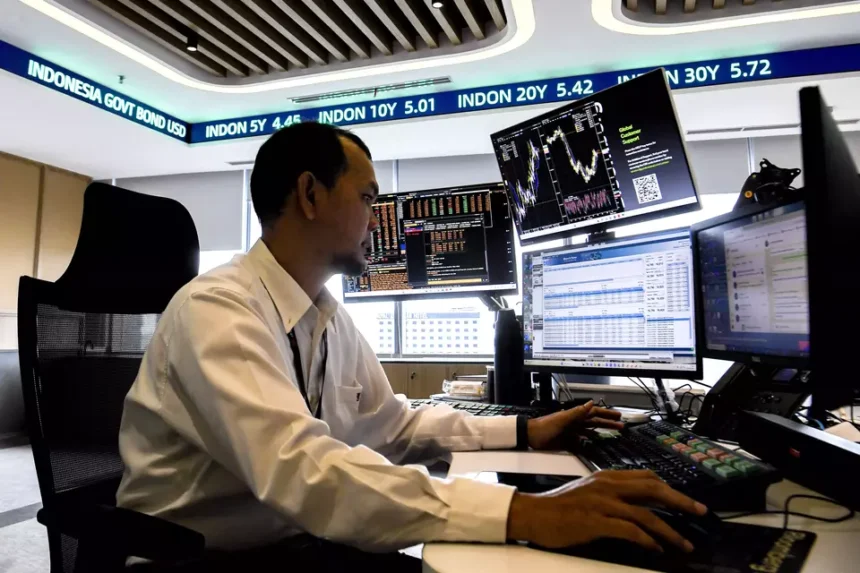
Market Volatility And Global Geopolitical Pressures On The JCI
The Jakarta financial landscape experienced a brief moment of optimism at Tuesday’s opening as the JCI climbed above the critical 7,000 threshold before quickly retreating into negative territory. This immediate reversal reflects a deep-seated caution among investors who are closely monitoring the prolonged conflict between the United States and Iran, which has now entered its sixth week of uncertainty. While the benchmark index initially rose 12 points to reach 7,001, the momentum was short-lived as rising oil-related fiscal pressures began to weigh heavily on market sentiment within just five minutes of active trading.
The JCI fluctuated in a narrow range between 6,978 and 7,015, demonstrating the sensitive nature of the local bourse to international diplomatic developments. Despite the early slip, trading activity remained notably robust with a total volume reaching 2.1 billion shares and a turnover of approximately Rp 1 trillion. It is interesting to note that gainers actually outnumbered decliners during this session, suggesting that while the headline index struggled, there were pockets of resilience within specific sectors.
The global atmosphere remains tense as Iran recently rejected a proposed ceasefire, demanding instead a permanent end to hostilities and new security arrangements for the Strait of Hormuz. This geopolitical deadlock continues to cast a long shadow over emerging markets, forcing local traders to adopt a defensive posture while waiting for a definitive breakthrough in diplomatic negotiations or a stabilization in global energy prices. The market’s inability to sustain the 7,000 level underscores the fragility of investor confidence in the face of unpredictable regional flashpoints.
Fiscal Resilience And Domestic Energy Policy Adjustments
On the domestic front, the Indonesian government has taken a firm stance to protect consumer purchasing power by reaffirming that subsidized fuel prices will remain unchanged through the end of the year. This decision is built upon recent calculations suggesting that the state budget maintains enough resilience to absorb these massive subsidies, even if global crude oil prices average up to 100 dollars per barrel. However, maintaining the JCI and broader economic stability comes with significant fiscal trade-offs that the Finance Ministry must carefully navigate.
Analysts suggest that every 1 dollar increase in global oil prices could potentially raise national subsidy requirements by Rp 6.8 trillion, a staggering figure that requires disciplined budget management. To keep the national deficit at the targeted 2.92% without depleting the excess budget funds, the government is planning strategic expenditure cuts across less efficient ministries and agencies. Currently, Indonesia holds a fiscal buffer of Rp 420 trillion in excess funds, with a substantial portion placed within the banking system to ensure liquidity.
Under these complex conditions, the JCI is widely expected to move sideways within a range of 6,900 to 7,100 as the market digests the implications of these fiscal maneuvers. Meanwhile, the aviation sector is already feeling the pinch, with aviation fuel prices in major Indonesian airports surging by over 72% in April 2026. This surge in input costs for transportation adds another layer of complexity to the inflation outlook, which institutional investors are watching with a critical eye as they assess the profitability of transport-heavy portfolios.
International Classifications And Structural Market Reforms
A major point of relief for the Indonesian financial sector came from the recent FTSE Russell review, which maintained the country’s status as a Secondary Emerging Market. This decision alleviated widespread fears of a potential downgrade that could have triggered significant capital outflows and put further downward pressure on the JCI in the short term. The review highlights that the impact of such classifications is often more about investor sentiment than immediate changes to index composition.
Nevertheless, the maintenance of this status is largely attributed to the successful implementation of several structural reforms within the Indonesia Stock Exchange. These include the mandatory disclosure of ownership data above 1% and the publication of a high shareholding concentration list, both of which enhance transparency for global fund managers. Furthermore, the revision of Exchange Regulation I-A has increased the minimum free float to 15%, a move effective as of March 31, 2026, which aims to improve market depth.
Overnight, US markets showed a cautious advance as they awaited a deadline set by President Donald Trump regarding potential military actions, a factor that continues to keep global energy supplies in a state of high alert. As Asian markets like the Nikkei and Kospi opened higher, the JCI remains caught between these global leads and the specific domestic challenges of fuel subsidies and fiscal discipline. The synergy between international regulatory standards and local economic policy will be the determining factor in whether the Jakarta benchmark can reclaim the 7,000 level.
Macro-Financial Stability And Regional Market Implications
From an expert B.I.F.E. perspective, the current behavior of the Jakarta market reflects a sophisticated tug-of-war between strong domestic fundamentals and extreme external shocks. We analyze that the government’s decision to maintain fuel subsidies is a calculated risk designed to prevent a sharp spike in inflation, which would have a far more devastating impact on consumer demand and long-term GDP growth than a temporary budget deficit increase. This policy provides a necessary floor for the JCI by ensuring that the primary driver of the Indonesian economy remains intact despite the surge in global oil prices.
The successful maintenance of the Secondary Emerging Market status by FTSE Russell will act as a catalyst for renewed interest from institutional investors who were previously sidelined by downgrade concerns. The increased transparency resulting from the 15% free float requirement is expected to improve the quality of capital entering the market, shifting the focus toward long-term value rather than short-term speculative gains. Furthermore, the surge in aviation fuel prices indicates that while the government can shield the general public, industrial and commercial sectors are already beginning to absorb the reality of high oil costs.
This divergence will likely lead to a sector-specific performance gap within the index, where energy producers and banks thrive while transportation and manufacturing face margin compression. We observe that the Finance Ministry’s plan to cut inefficient spending is a vital signal of fiscal responsibility that should preserve Indonesia’s sovereign credit rating. The synergy between these disciplined fiscal policies and the ongoing market reforms positions the Jakarta bourse as a resilient destination for regional capital, even amid the geopolitical storms of 2026. We anticipate that as the US-Iran situation eventually reaches a plateau, the Indonesian market will be well-positioned for a breakout.