




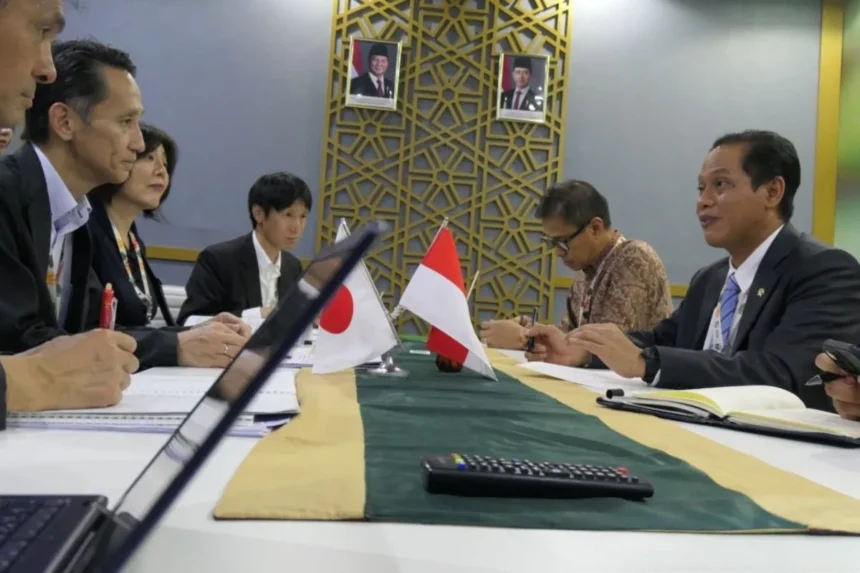
Indonesia and Japan Advance Bilateral Carbon Credit Trading
Indonesia and Japan are significantly accelerating their collaboration on carbon credit trading under a crucial bilateral agreement, a partnership that remains firmly aligned with the objectives of the Paris Agreement.
This step was publicly announced by Indonesian Environment Minister Hanif Faisol Nurofiq on Friday in Belém, Brazil, following a key meeting with his Japanese counterpart, Vice Minister for Global Environmental Affairs Kentaro Doi, during the 30th UN Climate Change Conference (COP30).
The primary focus of their discussion was to advance the Mutual Recognition Arrangement (MRA), an instrumental framework established to allow both nations to formally recognize the integrity and equivalence of their respective domestic carbon credit systems.
Minister Nurofiq stated that the two countries “agreed to continue MRA in operational efforts under Article 6.2, targeting greenhouse gas emission reductions,” emphasizing the practical implementation of this mechanism.
The discussions also extended into broader areas of cooperation beyond mere trading, encompassing critical climate change mitigation initiatives and the joint development of the necessary regulatory and technological systems required to effectively implement comprehensive climate action measures across both economies.
Operationalizing Article 6.2 Through Mutual Recognition
The Mutual Recognition Arrangement (MRA), which was initially signed at COP29 in 2024, serves as the fundamental mechanism to facilitate carbon credit trading in compliance with Article 6.2 of the Paris Agreement.
This vital article encourages the use of Internationally Transferred Mitigation Outcomes (ITMOs), effectively enabling countries to voluntarily cooperate to achieve their Nationally Determined Contribution (NDC) goals more efficiently.
The MRA specifically establishes that Indonesia’s Greenhouse Gas (GHG) Emission Reduction Certification system (SPEI) and Japan’s Joint Crediting Mechanism (JCM) are recognized as equivalent and interchangeable frameworks for this cooperation.
This equivalence is a monumental step, as it eliminates significant administrative barriers and bolsters the credibility of carbon credit units generated under both national schemes.
Minister Nurofiq previously highlighted that the “implementation of the SPEI-JCM MRA is a crucial step in operationalizing carbon trading under Article 6,” underscoring Indonesia’s commitment to producing high-quality carbon credits that are recognized internationally.
The ongoing joint efforts, which include “system development and implementing climate change management measures,” are geared towards ensuring the MRA not only supports bilateral targets but also upholds the critical principles of Transparency, Accuracy, Completeness, Comparability, and Consistency (TACCC) mandated by the Paris Agreement guidance for all market mechanisms.
Strengthening Indonesia’s Position in the Global Carbon Market
This enhanced partnership with Japan is a cornerstone of Indonesia’s broader strategy to elevate its position within the global climate action landscape and to effectively leverage market-based mechanisms while simultaneously safeguarding its national sovereignty and economic interests.
Experts in the field have noted that such bilateral arrangements are critically important for effectively scaling up global emissions reductions and for supporting the development of stable and transparent international carbon markets.
The agreement provides a clear path for Japanese investment into low-carbon development and mitigation projects in Indonesia, specifically those that utilize advanced decarbonizing technologies facilitated through the JCM framework.
Such projects, which span sectors like renewable energy, waste management, and energy efficiency, are now streamlined by the MRA, as the resulting carbon credits will be recognized by both countries’ official registries.
Both governments are committed to ongoing joint monitoring and comprehensive reporting to ensure the continued effectiveness and environmental integrity of the MRA.
This collaboration reflects Indonesia’s strategic focus on becoming a key producer of certified, high-quality carbon credits, a move that strengthens its commitment to its NDC goals and sets a powerful example for other bilateral collaborations under the Article 6 framework globally, reinforcing its role as a leader in climate finance development within the ASEAN region.
De-Risking ITMOs and MRO Efficiency
The formalization and active advancement of the Mutual Recognition Arrangement (MRA) between Indonesia’s SPEI and Japan’s JCM represents a significant de-risking event for the Internally Transferred Mitigation Outcomes (ITMOs) market under Article 6.2 of the Paris Agreement.
From a Finance perspective, this agreement institutionalizes fungibility between the two national carbon credit systems, which dramatically reduces the regulatory and sovereign risk for Japanese entities looking to invest in Indonesia’s vast mitigation potential, particularly in the nature-based solutions and renewables sectors.
The primary market impact is the establishment of a robust demand signal for Indonesian carbon credits.
Japan gains a reliable, high-integrity source of ITMOs to help meet its ambitious Nationally Determined Contribution (NDC) target, while Indonesia secures a premium, predictable buyer for its domestic credits.
This structured bilateral demand is likely to support a higher floor price for SPEI-certified carbon credits compared to the more volatile voluntary market, enhancing the attractiveness of climate projects in Indonesia for private foreign direct investment.
For the regional Economy, this MRA serves as a foundational blueprint.
It demonstrates a practical model for how two countries—one a major emitter and technology provider (Japan), the other a major carbon sink and project host (Indonesia)—can cooperate on climate finance without compromising environmental integrity.
This success story can accelerate similar carbon credit bilateral arrangements within ASEAN and with other advanced economies, potentially leading to a more interconnected and high-quality Asian compliance market.
The MRA also forces the Indonesian domestic system to operate at a higher, internationally scrutinized standard, thereby increasing the overall confidence and integrity of the Indonesian National Registry System (SRN-PPI) and creating a more favorable environment for subsequent international deals and investments.


